Canada’s oldest weekly newspaper
© 2026 The Picton Gazette
Since 1830


 24° Mostly Cloudy
 Editorial
There’s no better spur to action than reading a long list and realizing you are not on it.
For that, I commend the writers of the County’s two-years-in-the-making Cultural Heritage Master Plan.
WSP consultants were appointed in January 2024 to map the rich heritage resources of this island in Lake Ontario, inhabited first by Indigenous tribes of Iroquois, Cree, and Mohawks, and then settled in the late eighteenth century by British Loyalists, German mercenaries, and the black slaves they brought with them.
Long identified as critical to our sense of place, the natural and cultural beauties of PEC, its shorelines, cliffs, and farmed fields, red brick and limestone houses, centuries-old churches, and pattern of villages, hamlets, and towns set round mill ponds and creeks, are also a strategic lever in the competition for tourists.
While they compose a sadly neglected area of local economic development, however, the baseline is this: if the rich history of PEC is not noticed, appraised, and protected, it will disappear.
Much already has.
“Cultural heritage resources” is a broad term, and it includes landscapes and viewscapes as well as the more traditional buildings and places: if the Crystal Palace and Bloomfield Town Hall are listed in this Master Plan, so are the limestone cliffs on Picton Bay, and the beautiful views off County Road 13 as it sweeps through Grimmon’s Woods. Designating the more intangible components of a sense of place are a vital form of environmental as well as historical protection.
In this week’s issue we present the Master Plan Final Report on page 9, and include some of the long list of the places it recommends for designation. That list, however, is not exhaustive. Indeed, it seems to have been crowd-sourced: if a site wasn’t mentioned at a public consultation session, it is not in the report. So much for methodology.
The result is that those areas of the County that already receive vigorous protection — from the formidable likes of the South Shore Joint Initiative, the Field Naturalists, the representatives of Glenwood Cemetery, or the Friends of Delhi Park — are densely mapped. The more taken-for-granted areas — Cressy, Consecon, Sophiasburg, even Waupoos — are underrepresented.
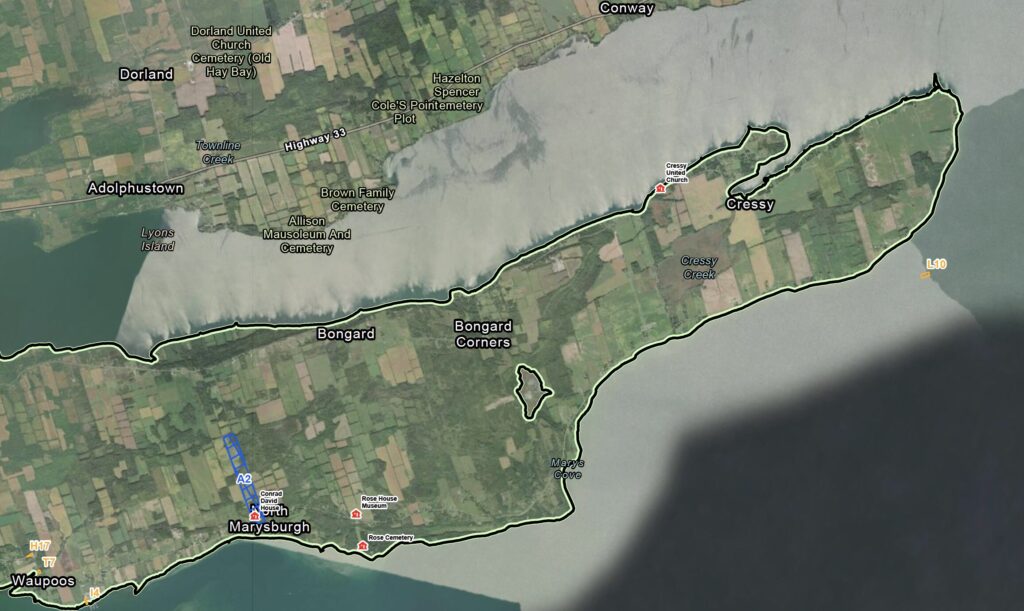
Sandbanks and Lake-on-the-Mountain are listed. But the Cressy United Church, founded in 1877, and Cressy Cemetery, whose earliest recorded burial is 1859, are not.
As I live just up County Road 7 from this petite, steepled, brick church, I was, I confess, a bit shocked. It anchors a historic curve of road from Kaiser Cross to Prinyer’s Cove, once home to a General Store — still standing — and an important public wharf, and dotted with centuries-old farmhouses of brick and wood.
North Marysburgh’s whole claim to PEC fame is that it was the first settled area of the County. The Master Plan notes this — but then seems to forget about it.
In October 1784, Lieutenant Archibald MacDonnell and a party of 153 men, 99 women, 67 children, and 2 “servants” — most likely slaves brought from America — landed in what was for a while known as MacDonnell Cove and is now called Prinyer’s Cove. Alongside the Lieutenant’s party, a group of 40 disbanded German mercenaries led by Baron Von Reitzenstein, and three more “servants” also landed here. Both groups started to clear and cultivate land across Cressy and Waupoos.
These were the first settlers of Fifth Town, one of the Ten Towns of Upper Canada and the fifth to be surveyed. The first was King’s Town, now Kingston. Our first township was soon called Marysburgh, in honour of Princess Mary, daughter of King George III.
Beautiful Prinyer’s Cove is still, two and a half centuries later, the site of a wharf and marina, though you would not learn this from the 200-page Master Plan.
The Rose House is an important landmark commemorating this first wave of settlers. A restored 1820s farmstead, it is now a museum filled with historical artefacts. Museums don’t seem to be listed in the Master Plan, so its absence is fair enough. But the omission means important landmarks could go by the wayside: Rose Cemetery is just south of Rose House Museum, close to the shore, and was known as The Old Dutch Burying Ground. But you will not find that in the Master Plan. Nor the fact that the very first church in PEC, built well before the famous 1809 White Chapel, once stood here as well.
Neither of the Anglican churches of Marysburgh, St. Philip’s or St. John’s, is listed.
Cressy United was recently re-christened the Cressy Glenora United Church; Glenora United Church, also dating to 1877, was de-consecrated and sold in 2020, and its congregation now comes to Cressy. That church was restored into a family home, but it still presides over Lake-on-the-Mountain: it summons a former century just by its presence. It is surely a candidate for a cultural heritage designation. But it is not here either.
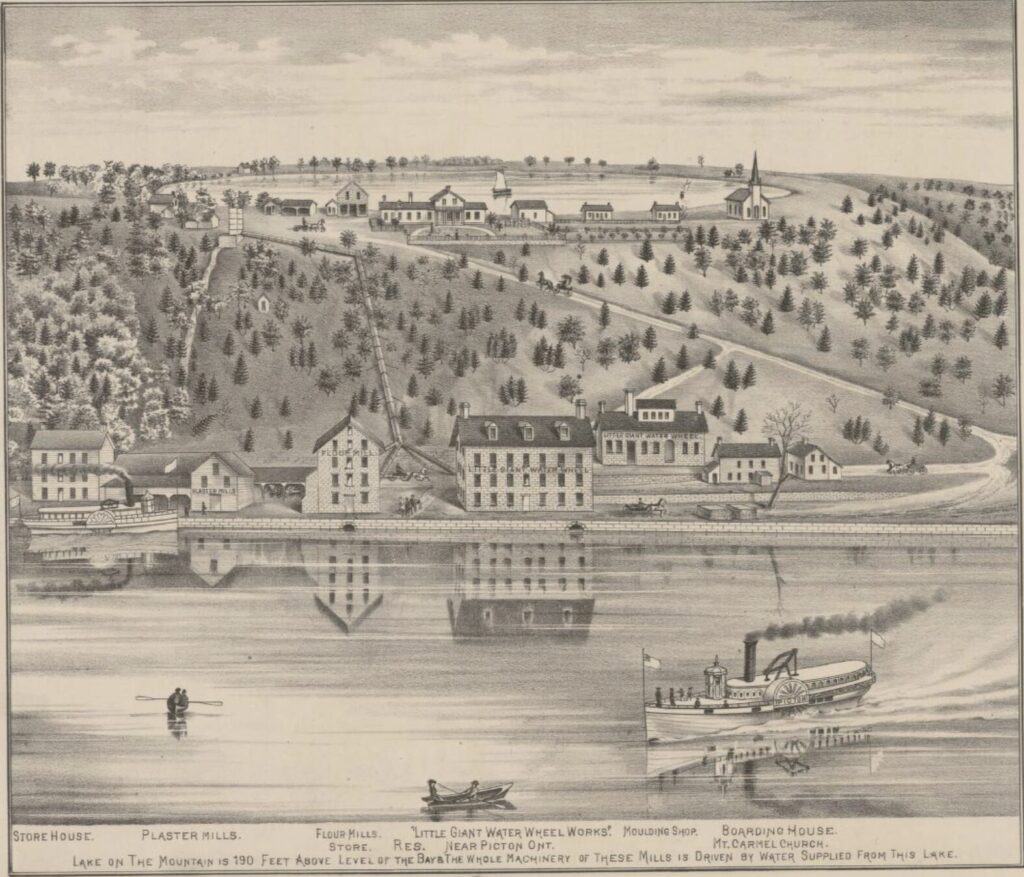
I should note that it was never the intention of the report’s writers to offer an exhaustive list; it is equally true that practically everything in PEC could be listed. The enormity of the task here is thrilling — and inspiring. For what this report was meant to do it does very well: first, it creates a framework for designating heritage sites in the future. It lists every single lighthouse in PEC, for example, including those on the small islands that surround it, as of cultural heritage value. It notes that Base31 deserves heritage designation. It suggests the limestone cliffs on Picton Bay could be designated — meaning, perhaps, protected from quarrying as well as from further industrial activities. It flags shipbuilding, fishing, transportation, and agriculture as key categories for attention.
Second, if the Master Plan’s recommendations are accepted, when it comes to municipal planning, economic development, and tourism promotion: all will have to keep PEC’s rich cultural heritage front and centre.
The report comes to Council in February. In the meantime, there’s still about ten days before the deadline of January 26 for public comment on the Have your Say portal. Have a careful look at its maps and lists before that. If something is missing, join the crowd — and Have your Say.
I certainly will.
See it in the newspaper