Canada’s oldest weekly newspaper
© 2026 The Picton Gazette
Since 1830


 11° Sunny
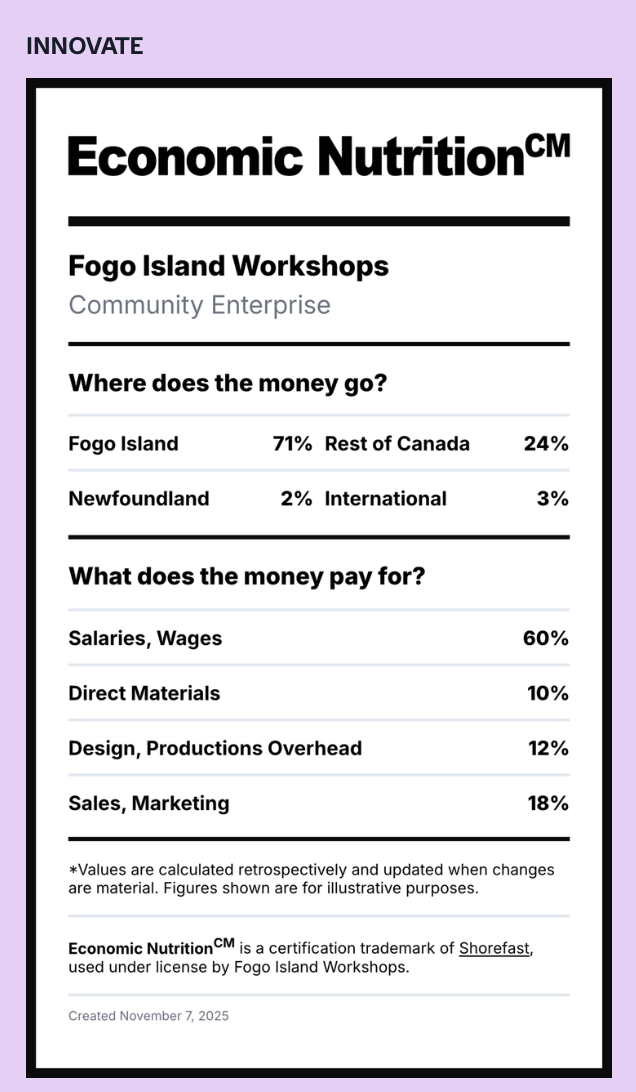 Shorefast has designed an Economic Nutrition Certification program.
The Gazette has joined the Shorefast Institute’s Economic Nutrition initiative, a program to help develop truly place-based economies, one business and community organization at a time. Economic Nutrition Certification is a way to move toward a key goal: keeping the money that is made in PEC inside PEC. Shorefast did a study of the County as part of its Community Economies Pilot in 2021. We present here excerpts from that report. In future instalments, the Gazette will share what it learns as it undergoes the certification.
The Community Economies Pilot
In The Third Pillar, economist Raghuram Rajan studies the three key community pillars: government, business and community, and finds a neglected, weakened community pillar. Until we see community as an integral part of resilience, the economic system will be out of balance, failing the communities it is supposed to serve. The Shorefast Institute is focused on strengthening the community pillar, to make it an integral partner to business and government in economic and community development.
Historically, PEC’s economy was based in the maritime sectors of boat building, fishing, and shipping, as well as a strong agriculture sector with a flourishing canning industry, dairy industry, and cheese production. These were the two main economic drivers well into the twentieth century — and had all but disappeared by the 1980s, the result of global industrialization.
Over the last 30 years, however, PEC has been rediscovered as a tourism destination, a result of its wine and culinary offerings and its vibrant arts and culture community. Today, the four strongest economic sectors are:
1) tourism, accounting for 31% of all jobs;
2) agriculture, which, although not a large employer in the economy, is responsible for the largest amount of economic activity;
3) new home construction and renovations, a significant growth area of the economy; and
4) manufacturing of beer, wine, and cider, rooted in local agriculture.
99.4% of PEC’s businesses have fewer than 100 employees, and almost half of those are microbusinesses employing 1-4 people.
As is common for rural economies, 51 percent of the workforce is engaged in seasonal or part-time employment and many people report having multiple jobs to make ends meet. 25 percent of workers are employed in food services, accommodation, or retail, sectors with the lowest average weekly earning rate in the community. As a result, PEC is 10 percent lower than the Ontario average for household income.
PEC is a single-tier municipal government, resulting from the amalgamation in 1998 of the island’s 10 small towns and villages.
The County views its human capital as a critical asset; there is a very large, active volunteer base bolstered by an inflow of new residents (according to the most recent census, the population rose for the first time in more than a decade to 27,000), with diverse and strong skillsets.
This demographic shift is also causing some tension in the community, exacerbated by investor-driven tourism projects and several large-scale housing developments, potentially doubling the size of Picton and tripling the size of Wellington in the next 30 years.
On the other hand, this population base has a strong entrepreneurial spirit and small and microbusinesses are the primary creators of jobs. Business creation in the County is driven by entrepreneurship, not large business relocation.
While PEC’s high school graduation rate is at 76 percent, versus 88 percent across Ontario, and although there are no postsecondary institutions in the County itself, it is relatively close to Queen’s University in Kingston, and
Loyalist College in Belleville. A technical college, the First Nations Technical Institute, is in Tyendinaga, and Prince Edward Learning Centre is a basic skills and job training institute. Mentoring and support programs are also being put in place to help increase graduation rates.
Like most areas in the country, there are jobs available, but a shortage of workers to fill them. Seasonal employment and short operating seasons mean it is hard to attract workers; there is a shortage of educated and skilled labour.
This is in part due to a need for skills upgrading, and internships, as well as finding housing for those who would be able to find employment but not necessarily have the incomes to be able to find a safe, comfortable place to live.
Connectivity is an issue as in many rural communities; in Picton and Wellington, there is access to faster internet, but there is uneven coverage on the rest of the island. This is particularly problematic as 65 percent of the population lives outside of these centers.
PEC faces complex issues that require input from diverse groups, businesses and citizens. Sustainable community economic development isn’t something that community groups, nor local businesses, can take on by themselves. Nor is it just the municipality’s responsibility. Only by everyone working together to tackle these knotty issues can they be solved to the benefit of all.
The Shorefast Institute, Community Economies Pilot
See it in the newspaper