Canada’s oldest weekly newspaper
© 2026 The Picton Gazette
Since 1830


 9° Clear
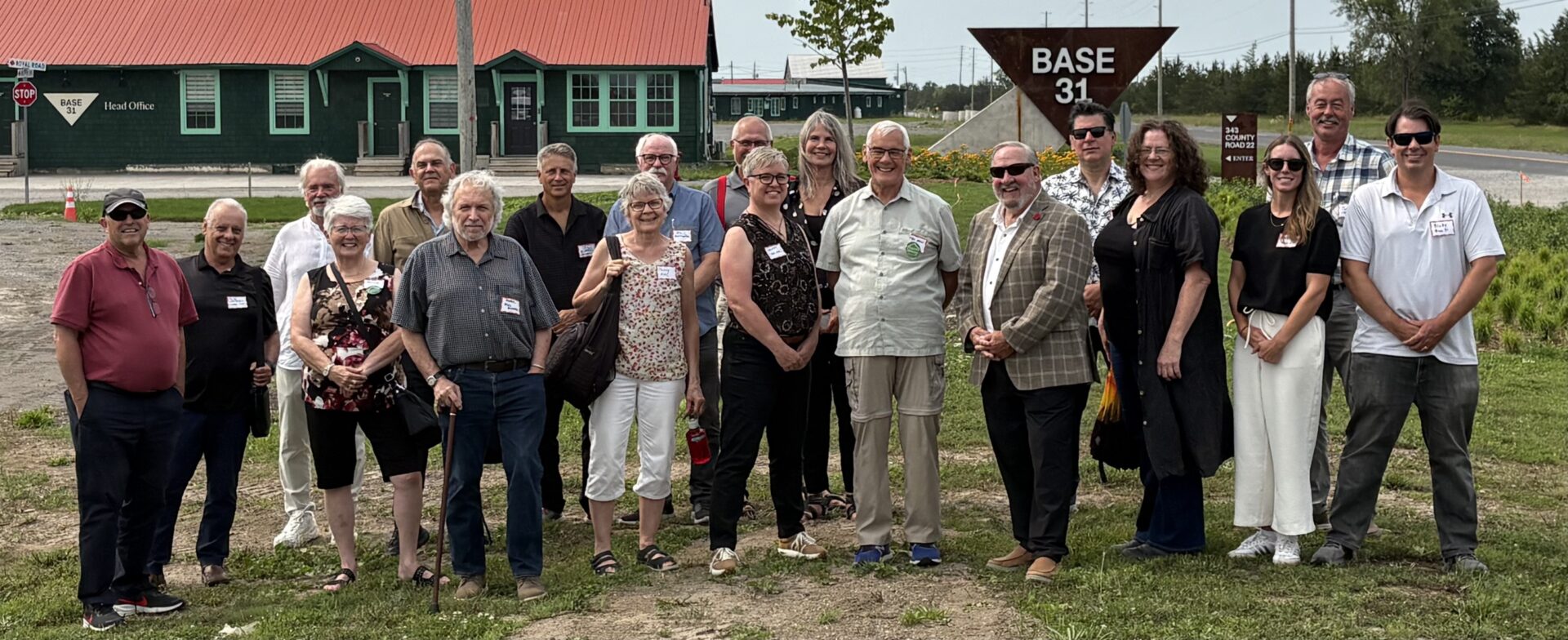 Participants in the Prince Edward County Affordable Housing Summit gather at Base31, one stop on the tour of five development sites (Brittiny Blodgett/GAZETTE STAFF)
Prince Edward County has no shortage of plans for affordable housing. The trouble is getting from the drawing board to the people who need homes.
Navigating the leap was the focus of a day-long Affordable Housing Summit August 10, organized by the Prince Edward County Affordable Housing Corporation (PECAHC), Director of Housing Elis Zeigler, and CEO Adam Goheen.
The day included a two-hour tour of 5 building sites, lunch at Shire Hall, and a roundtable with Bay of Quinte MP Chris Malette, MPP Tyler Alsopp, councillors, developers, housing advocates, and community organizations.
The big news of the day was Rockport Group VP of Planning and Development, Kathryn Randle’s, announcement that construction on Hilltop, Base31’s first village, and its 7-storey purpose-built rental apartment building, would start in October. The Base expects its first residents by 2027.
Elsewhere, projects are moving more slowly.
At Pinecrest, 58 affordable and super-affordable units are planned for the former Bloomfield school site, with another 100 to 200 units contemplated elsewhere on the property.
At Picton’s Disraeli Street, an eight-unit modular rental building is in the works. Base31, Nicholas Street and the former Queen Elizabeth school were also on the tour.
The same questions followed the group from stop to stop: How much affordable housing can be built? Who pays for it? The big question was: when?
The County’s 2024 housing plan says we need 2,700 purpose-built rental units, 1,350 of them affordable, and 150 supportive, or subsidized, units.
At Nicholas Street, developer Alan Hirschfield is building 120 rental units, 25 percent affordable. Queen Elizabeth will supply 230 rental units, 30 per cent of them affordable, and dedicated seniors’ housing, along with space for municipal and community services.
The roundtable discussion asked what keeps housing projects from moving forward, and what governments must do to help.
Affordable Housing Corporation member Mark Guslits asked whether with additional government funding Base31 would increase its affordable component beyond the 10 per cent planned for the rental building.
“If there was funding forthcoming, could we come back to you and push you along those lines?” he asked.
A rep said the partners were open to the possibility.
At the Queen Elizabeth redevelopment, Mr. Hirschfield said additional support through Build Canada Homes would certainly increase affordability.
“Rent subsidies specifically apply to supportive housing,” Mr. Hirschfield said. “That’s the area that we need assistance on, and we can increase the amount of supportive housing as a result of that.”
He also noted long approval timelines can make housing projects less viable.
“Longer approval processes increase carrying costs.”
MPP Tyler Allsop agreed. “Time is money,” he said, adding that faster approvals reduce carrying costs for developers.
The Disraeli Street project poses another challenge: whether the region has the construction capacity to deliver modular housing at the scale it needs. The eight-unit project is a modular housing development designed to provide affordable rental homes on County-owned land, and is one of the local projects being advanced with support from Build Canada Homes.
Ruth Estwick of the Quinte Home Builders’ Association said there are just one or two modular builders among the association’s members but that the industry is growing. “I think that more technology is coming,” she said.
The County received no local response when it sought a contractor for the Disraeli project, highlighting the gap between the growing interest in modular housing and the industry’s current capacity to deliver it.
Councillor Kate McNaughton suggested smaller modular projects could also provide a way to add housing within existing neighbourhoods and using existing infrastructure.
“We’re all looking at building affordability into not just a home or a small apartment building, but also a community, using those already serviced areas, it’s so exciting because we’re not adding infrastructure except maybe extending a pipe,” she said.
“Affordability cannot be addressed by any one organization or any one level,” Ms. Estwick said. “We all have to work together.”
MP Chris Malette pointed to more than 1,600 approved housing units in Belleville. “What’s keeping shovels from going in the ground?” he asked. “Money.”
MPP Typer Allsop said housing takes too long and costs too much to build, while the County’s high home prices make it difficult for many people who work here to afford to live here.
Mayor Ferguson said the municipality also has a role to play.
“We as a municipality have to enable you to get to yes quicker,” he said.
With the preliminaries established, the meeting moved into closed session for focused discussion with federal and provincial government representatives.
By Ian Chodikoff
Last week, I walked through the buildings where Prince Edward County’s housing future is being worked out — one site at a time.
I’ve just joined the Board of Directors of the Prince Edward County Affordable Housing Corporation (PECAHC), and there was no better introduction than our Housing Summit tour across the County. The tour included:
•New View’s Nicholas Street Homes (Picton) — 120 units, 30 of them affordable
•Pinecrest Housing (Bloomfield) — 58 units of affordable housing anchored by a community hub
•PECAHC’s own project at 30 Disraeli Street (Picton) — 8 units of affordable housing
•New View’s Queen Elizabeth Residence (35 Barker Street, Picton) — 209 rental units, including 75 seniors-oriented units and 63 affordable homes
•Base31 (Picton) — 12 affordable units in their first 7-storey, 120-unit apartment building, and 5 percent affordable across a multi-decade, 7,500-unit build-out
The County has a housing paradox. It’s a place people love to visit and retire to — yet rental vacancy is near 0.2 percent, among the lowest in Canada, and roughly 800 households are in core housing need. We don’t need more detached homes; we need affordable rentals for single, older, and modest-income residents — the neighbours who keep this community running.
What struck me on the tour is that the answer is already taking shape, in different forms and at different scales: a non-profit hub, a seniors’ residence, an eight-unit infill, the generational redevelopment of a military base. The projects range from infill development that makes better streetscapes to seniors’ housing and community hubs that contribute to inclusive neighbourhoods.
PECAHC’s role resonates with me as an architect — not just building, but facilitating: contributing land, securing long-term tax relief, and bringing partners together so the right housing gets built.
All housing is an economic development issue. We need to be diligent about financing and speeding up its delivery across Canada, not just the County.
See it in the newspaper