Canada’s oldest weekly newspaper
© 2026 The Picton Gazette
Since 1830


 0° Clear
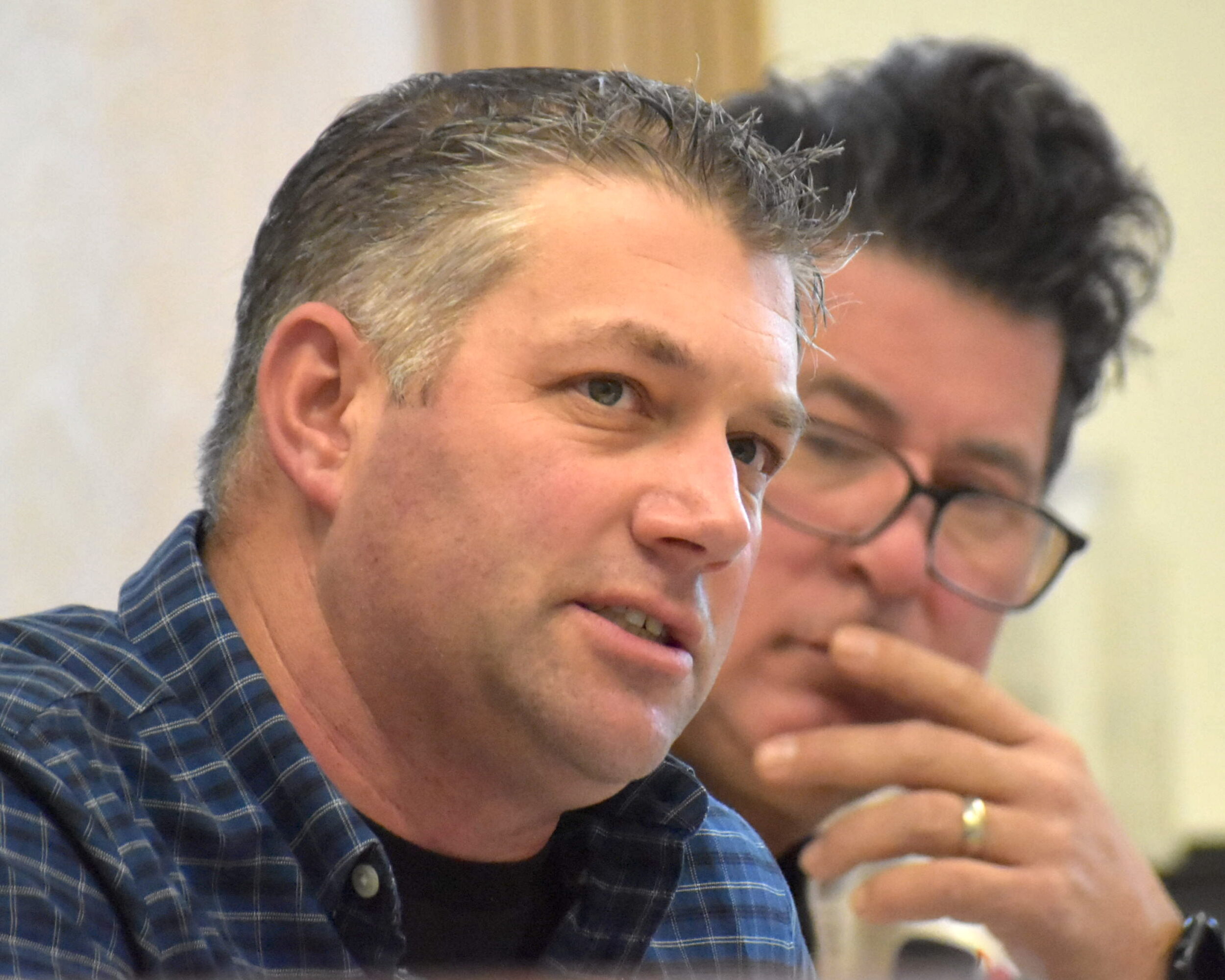 Councillor Sam Grosso ponders a point made by councillor Phil Prinzen during 2026 budget deliberations. (Jason Parks/Gazette Staff)
The proposed hike is what’s left after new tax base growth is factored in. It means an extra $100 a year for the average home, which MPAC values at $267,000.
Four full days went to operations and capital budget presentations from staff. Hundreds of line items were under scrutiny.
“My wife threatened to change the locks if we passed an 11 percent increase,” said a relieved Councillor Bill Roberts Friday morning. “So thank you to everyone here for the work you’ve put in this week.”
It was the first budget as a Strong Mayor for Steve Ferguson. He opted for the familiar, collaborative process. Slowly but surely, conversations between councillors and staff found the savings.
–Mayor Steve Ferguson
One of the first questions asked when Strong
Mayor Powers were announced was,
will the budget still be a collaborative process.
That’s precisely what we’ve undertaken.
Thank you to everyone in this room for
getting together on this budget.
Capital Deliberations
Beleaguered councillors nervously eyeing a double digit tax hike at the outset of the Capital Budget deliberations last week were offered a reprieve early on. A motion from councillor John Hirsch stopped a proposed $3 million trunk route reconstruction project for County Road 1.
The multi-year project will eventually see reconstruction from the roundabout all the way to Highway 62. An initial phase, slated for 2026, was to commence from the roundabout to Mallory Road. About $50k has been spent on a preliminary design study.
Delaying the project, and taking the earmarked gas tax funding for other projects, lopped about 5 percent off the projected 11 percent levy.
“That $3 million could be redeployed to existing road projects,” Councillor Hirsch said. “Simply put, that saving of $3 million could save up to 6 percent in one fell swoop.”
With the County Road 1 project shelved for another year, Council continued to slice and dice.
It took a pass on repaving the King Street Parking Lot for a savings of $264k. Ending the Shoreland Designation Project will net $75k in savings. But perhaps the biggest line item removed from the budget outside of County Road 1 was a $954k for a drinking water booster station for the Pineridge Subdivision. A proposed $1.3 million culvert project for Main Street in Wellington may not see the light of day — at least in 2026.
Surviving were two rural intersections that will see new lights. Major reconstruction projects on Barker and Bowery streets to address both surface and underground infrastructure needs will move forward, as will work on a section of County Road 3.
Water and Wastewater
The water department is completely user funded and does not draw on the tax levy. Councillors were loath to poke around Director Don Caza’s Water and Wastewater budget, which was mostly routine in nature and dictated by lifecycle replacement schedules for equipment at Peats Point, Picton and Wellington. The Picton plant needs four new chemical pumps to treat raw drinking water. In Wellington, a lag in the new plant coming online means a $600k investment in new filters for the old one.

Councillor John Hirsch wondered if there was any other capital costs in the offing due to delays.
“Other things pop up when you prolonging assets beyond their life cycle,” said Mr. Caza, adding that if the new Wellington Water Plant started construction today, it wouldn’t come online until 2029, so the filter investments were necessary.
At the outset of his presentation, Mr. Caza reminded Council about Standard of Care clauses in provincial legislation. They obligate municipalities to maintain drinking water systems to a certain level.
“I don’t think anyone wants to mess around with the water, considering the history in this province,” Mayor Ferguson said.
Operational Services
Construction & Technical Services Supervisor Ronnie Joslin walked Council through the 2026 Rural Roads Program, which focuses on treating “the right roads at the right times,” with single or double surface treatment, micro, and crack sealing to extend service life while managing costs.
The County will spend $4.5 million for rehabilitation, preservation, and preventative maintenance work on more than 63km of rural roads in 2026. That is an increase of $874k over 2025, and will come from the Reserve for Roads Construction – Rural ($3.5 million) and the Reserve for surplus Municipal Accommodation Tax ($1 million).
The program is informed by the Roads Needs Study and Asset Management Plan.
Mr. Joslin noted all roads identified in the Roads Needs Study are assessed in the spring after winter’s freeze-thaw cycles. Surface treatments are completed by contracted services. Sections of Salem and Victoria Roads are included in the 2026 program.
The County will also spend $75k on erosion mitigation strategies along County Road 13, or Long Point Road. The funding is earmarked to develop and implement measures that address the slope stability concerns along Lake Ontario. There are areas where the roadway is precariously close to the shore line.
PEC Fire & Rescue
In a rare instance, Council added to a departmental capital budget on Tuesday. With its land ambulance contract with Hastings-Quinte Paramedic Service (HQPS) set to expire at the end of 2026, Council chose to purchase a $370k spare vehicle. Chief of Emergency Services Carl Bowker recommended a spare ambulance for the Picton station in order to cover regional needs during periods of high service calls.
Councillor Janice Maynard sits on the regional EMS board, and she noted a spare ambulance “is not a nice-to-have, it’s a must-have to meet the obligations of our next contract, unless we want to go it alone with our own ambulance service.”
Editor’s Note: A previous version of this story erroneously valued the County’s Shoreland Designation Project at $175,000.
See it in the newspaper