Canada’s oldest weekly newspaper
© 2026 The Picton Gazette
Since 1830


 11° Sunny
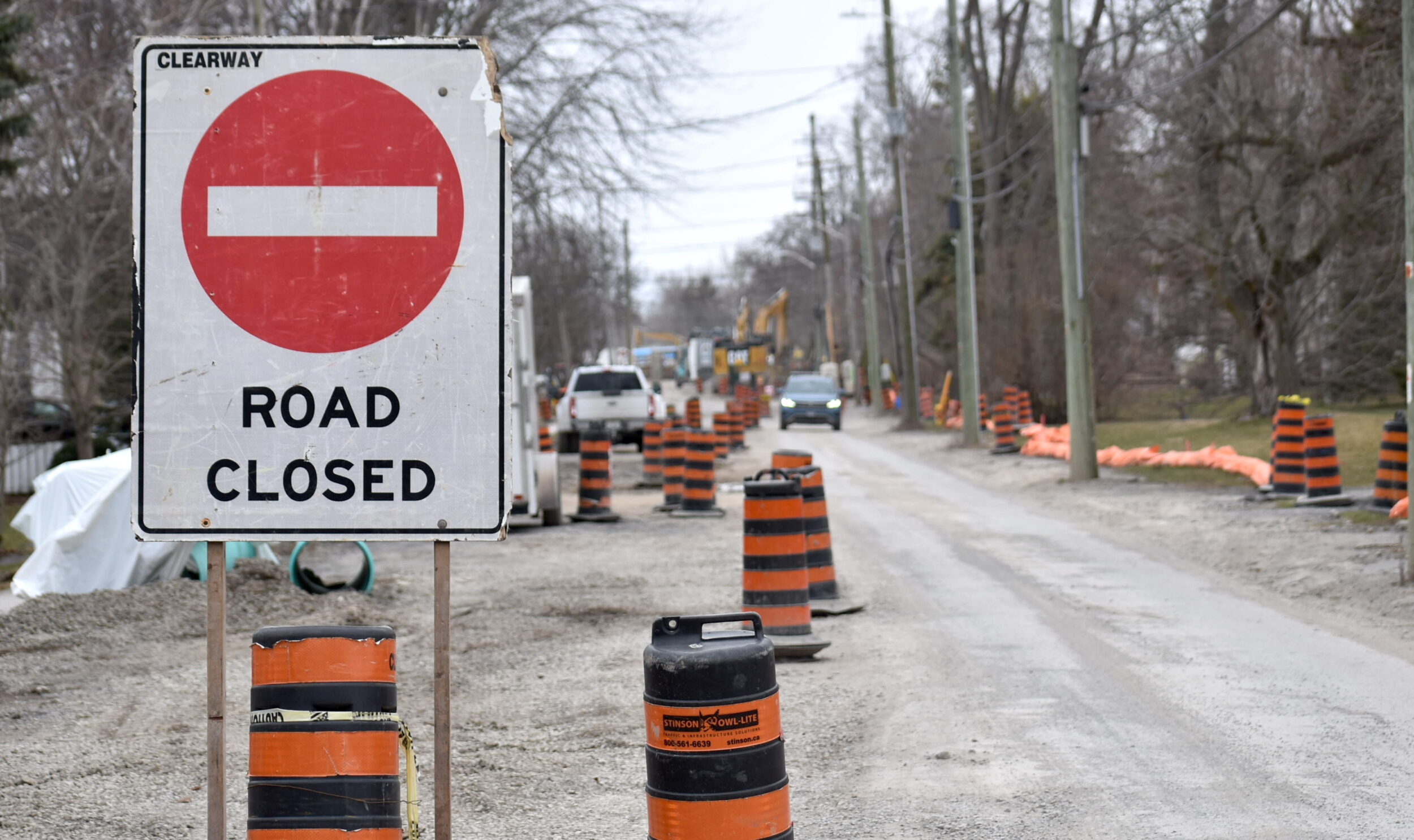 Wellington Main Street looking west during water infrastructure improvements in April, 2025. (Jason Parks/Gazette Staff)
The Committee of the Whole considered the implications of the latest growth projections from Watson & Associates on its water infrastructure plans last week.
The 2025 Watson report reduces its previous, 2023 population growth estimate from an average 2.4 percent a year to just .08 to 1 percent a year.
Councillors resolved to review its plans in light of the reduced projections. It may decide to scale back infrastructure investments it had planned for the coming decade.
On the table is a $205 million commitment to expand the County’s failing water infrastructure.
The report cites the immediate context to account for slicing a projection made just two years ago. Interest rates, a slowed housing market, and a federal policy shift on immigration most expect to be temporary were key factors in its forecast of moderate or even slow growth over the next 25 years.
Watson’s predictions fall short of both StatsCan’s national population growth forecast, released on January 27, as well as the province of Ontario’s. Both sketch high-growth scenarios of 1.3 percent a year over the next 25 or, in the national case, 50 years.
Eastern Ontario, which includes the County, is the province’s fastest-growing region. It is expected to rise from 2.1 million to almost 3 million people, a growth rate of about 1.3 percent a year.
On the table is a $205 million
commitment to expand the County’s failing water infrastructure.
A detailed staff report prepared by Director of Development Services Cristal Laanstra reviewed water infrastructure investments and plans to date. Top of mind is whether the phases of water servicing expansion, and the financial commitment required, could be stretched over a longer term given the reduced growth projection.
Two scenarios are under consideration. The first is to proceed as planned, committing $205 million to waterworks infrastructure by 2036. Those plans include a new, regional WTP in Wellington, and drinking water piped to Picton, whose WTP will be decommissioned.
The second is to scale back now, and build out over a much longer term. That decision requires careful study. While it could yield immediate financial relief, reducing upfront investment to just $69 million over the next decade rather than $205 million, the decision would cost $100 million more over the long term.
It’s a question of paying now or later to build the same infrastructure. Inflation and other structural costs would only add to the final tab, not reduce it.
There’s also concern about an aging and maxed out system. It is not clear whether capacities at the water and wastewater treatment plants in Wellington and Picton can be expanded indefinitely. Picton’s WTP is at end of life. Scaling back would require its use to 2040.
Condition assessments are required to see if slowing down is even feasible. Councillors approved two new studies to report on the capacities of the plants, and an amendment to explore modular wastewater treatment technologies over the shorter term.
A host of developers attended the meeting to contest Watson’s diminished forecast.
Sterling Homes’s Paul Mandell wants to build 200-250 units of infill housing in Wellington, but, he noted, “we wanted to be able to confirm a start date by now but there’s not enough sanitary sewer capacity to support our project.” He advocated modular, decentralized wastewater treatment systems, “to add new treatment capabilities based on real rather than forecasted growth.”
“These portable systems are incremental and expandable, offering just-in-time delivery, to match natural, real growth,” he stressed. Such systems — a container the size of a transport truck trailer can service 150 homes — are already being used in Quinte West.
“This is a way to avoid spending millions and millions of dollars and still go ahead with development,” agreed Councillor Brad Nieman.
Andrew Eldebs of Cachet Homes is acquiring 200 acres of land west of Consecon to build new attainable housing outside of the GTA. “The many large-scale new builders now in the County will change the historical pace of building permit activity,” he said, over both the near and long term.
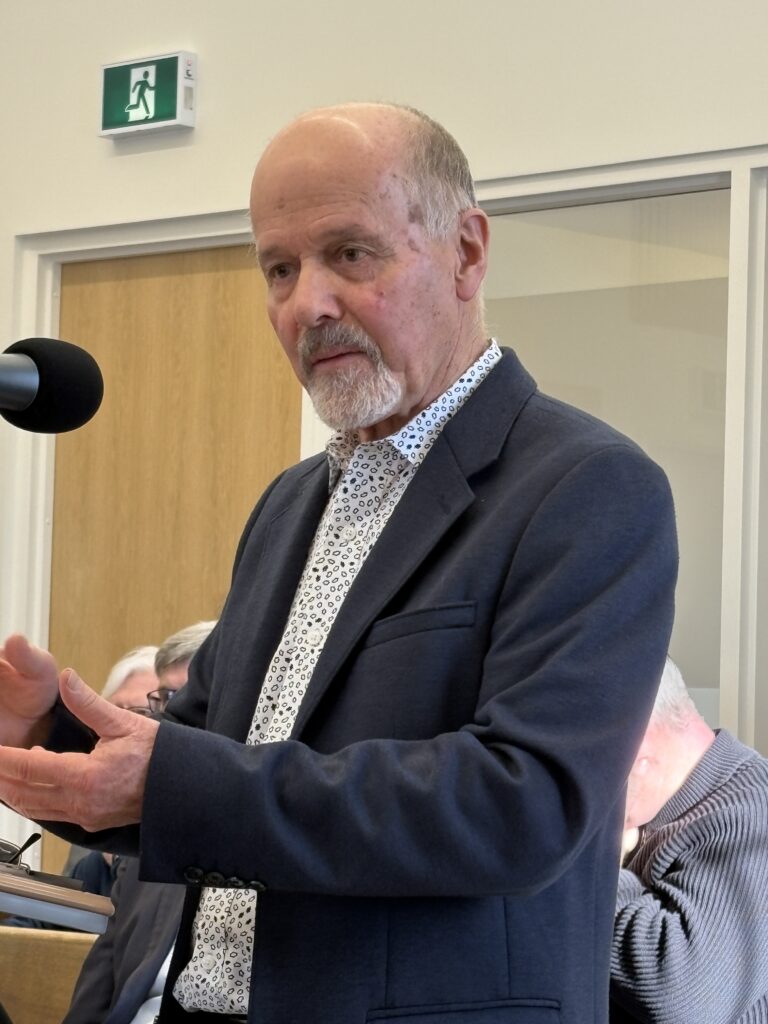
Fred Heller of FLC Group represented Vineridge Towns, which sits on 31 acres at Nery and Inkerman in Picton Heights. He described the new neighbourhood as a “low-density, low-rise development of 432 homes priced at below-average cost and aimed at first-time buyers and young families.”
He said the project is designed to “capture a market being pushed to surrounding communities by higher prices.”
“While market conditions have changed since we started the project, the underlying affordability objective remains,” he said. Vineridge’s townhouses will be offered at prices lower than the PEC average, positioning the County to attract those leaving the GTA over the next decade. “This is exactly the kind of project that can help PEC respond.”
Mr. Heller stressed that he would start to build, “as soon as both market conditions and water servicing allow.”
—Habitat for Humanity’s Hazzem Koudsi
“The shortage of quality, affordable homes creates
an exodus of families from the region.
People go and find jobs
where they can afford to live.”
Christopher Marchese represented Base31’s developer consortium, PEC Community Partners. He noted, like every other developer in the room, that the real estate market is soft, but stressed, “even though the market isn’t where we all want it to be, we still believe the market is here in PEC.”

“We want to be prepared by investing now for when the market picks up,” he said. “That’s when we will need the infrastructure for growth.”
The forecast growth rate could perhaps be reduced for planning purposes from the previous 2.4 percent high-growth scenario, he noted, but Watson’s 1 percent rate is “just not the right number.”
Base31’s Village A and Apartment Building A are both underway; Village A’s homes go on sale this summer, and will be move-in ready by 2027, while work on the apartment building will start in June of this year.
“We are not planning for tomorrow,” he said. “We are planning for 30 years from now. It’s critical we work together in collaboration, so that whatever the number is for growth, the infrastructure is there to allow it.”
All of the developers stressed that growth cannot happen without new homes. Ms. Laanstra noted that what looks like low building permit activity only reflects the fact that the servicing is not in place for would-be builders.
“Staff have been turning developers away at the door before they can even reach a permit and approval stage as they are aware we have limited capacity.”
The County’s growth rate has historically been slowed by the lack of infrastructure, she noted.
Facing skepticism from Councillors, whose concerns included worries that nobody wants to move here; there are very few jobs, and any new homes will just sit empty, the PEC Community Partners’ Mr. Marchese agreed that attracting new residents and creating new jobs was a bit of a “chicken and egg” problem.
“We believe you need the housing first. Everything follows from that.
“No growth-enabling opportunities is the worst solution possible for the County.”
Ruth Estwick, CAO of the Quinte Homebuilders Association, spoke on behalf of the newly formed County Development Advocacy Group (CDAG), which “represents 10 large landowners in the County with long-term investments representing 15,000 homes.”
She stressed that developers are ready to collaborate financially to ensure infrastructure is there when they need it.
Habitat for Humanity’s Hazzem Koudsi spoke of the “exodus” from the County because of its lack of affordable housing.
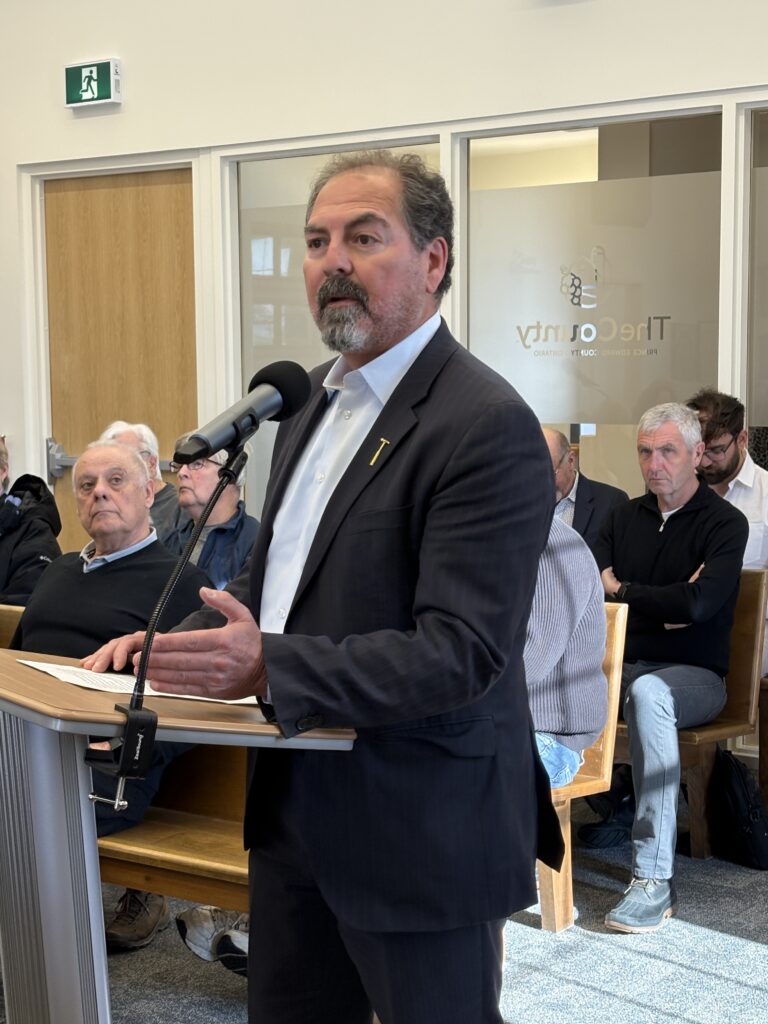
“The shortage of quality, affordable homes creates an exodus of families from the region. People go and find jobs where they can afford to live.” He noted that PEC’s home prices were up to a third higher than in the surrounding regions. “Higher prices are a function of supply.”
Habitat is trying to build a multiplex on Bowery Street in Picton. “There is an opportunity for 3, 4 or 5 homes there, but the current infrastructure is just not sufficient. There is not enough water on that street for even one more house.”
Councillors unanimously approved a motion calling for condition assessments on Wellington and Picton’s water treatment plants, and directing staff to more fully investigate the implications phasing in servicing infrastructure over a longer term. Ms. Laanstra promised a full report by June.
See it in the newspaper