Canada’s oldest weekly newspaper
© 2026 The Picton Gazette
Since 1830


 13° Mostly Cloudy
 Editorial
It was a strange spectacle. Five men, comfortably ensconced in the ergonomic chairs that ring the horseshoe at Shire Hall, laptops open, names on placards in front of them. Roy Pennell. David Harrison. Chris Braney. Phil Prinzen. Brad Nieman.
To a man, they were protesting, loudly and out of order, a decision to reconsider a motion that had failed in two tie votes.
One was to increase councillor pay. The other was to keep it the same.
Wrangling often comes down to procedure when the matter on the table is vexed. As in a court of law, it’s sometimes the best way to win the day. Declare the happenings somehow out of order. Disallow the evidence.
At Shire Hall, a tie vote is a failed vote. That meant the five would have won their case: no pay increase for our elected representatives. Not even to a living wage.
It was strange, as I say, to see five councillors insisting they would rather die than allow that the job they were doing should be properly paid.
“I’ve never supported a raise in the 12 years we’ve sat here,” said Councillor Nieman proudly. “I’m happy with the pay that I get.”
Councillor Pennell explained that his constituents who could not afford to buy groceries would be offended, knowing he had just awarded himself a pay increase.
It did not occur to Mr. Pennell that someone who can’t afford groceries cannot afford to sit in one of Shire Hall’s comfortable chairs, either.
For what is very close to a full time job, PEC councillors earn $30k a year.
And yet there have been years of debate on this very subject. I remember Councillor Kate MacNaughton, a single mother, bravely broaching the matter of paying councillors properly for the work they do with her fellow, almost entirely male, councillors four years ago. The same gang refused to even consider such a thing. The rationale is generally something gentlemanly, along the lines that this is not a job one does for the money. It is instead some sort of “passion project.”
The trouble is, that limits those who can do it to those who can afford to do it. As Ms. MacNaughton has been pointing out for years, that is discriminatory.
The current version of the compensation debate has been underway for six months. Council asked for a report on municipal payscales in January. It was debated May 14, and sent back for more data.
As Mr. Nieman put it, “you didn’t get the report you wanted, so you sent it back and told them to change it.”
But in January, Council had directed staff to consider “equity, inclusion, equity-of-access and scope-of-work factors” in the review. The first report didn’t mention equity. Under scope of work, it found that most councillors consider the job to be full time, over 30 hours a week.
That in itself is a barrier to participation: if the role entails a full-time, or near full-time, commitment, those considering the job must contemplate either reducing current paid employment or, if that employment does not have built-in flexibility — another luxury item — leaving it altogether.
If, at the same time, the pay is so low that you can’t live off it, then how many people, realistically speaking, can afford to run for elected office?
The question is pressing: an anemic municipal election is underway. Just seven people have so far come forward to stand for one of Council’s 14 positions. Most of them are already in office.
The new report, debated this month, included more data on compensation in single-tier municipalities, and on a living wage in Eastern Ontario. That is $22 an hour, well above the $17 minimum wage. If councillors were paid a living wage for 35 hours a week, they’d earn $40k a year. Not a princely sum by any means, but better than what they are earning now. That sum is like some kind of honorarium.
You do not have a practical democracy if only a few retired people living on comfortable pensions can afford to serve. Compensation for councillors must be set at a living wage. This should not be an argument. It should be a given.
The new report offered three scenarios corresponding to three different compensation frameworks: pay could be set at the average of 19 comparator municipalities; it could be set at the average among just single-tier municipalities, or it be set within a living wage framework, based on the principle of equity of access.
In every one of these scenarios, current councillor pay falls short.
And yet the boys’ club rejected all three. They want the “status quo.” Forever.
The real fireworks started, not around the two deadlocked and therefore failed votes — failed votes meant, somehow, they’d won — but when they had to face the fact that the two failed votes had failed to resolve the issue.
The next item, as Clerk Catalina Blumenberg pointed out, patiently and repeatedly, would have to be a motion to reconsider the matter, or there would be no compensation framework in place at all.
Seems reasonable, does it not? You’ve debated and discussed and debated again. You cannot find a resolution. That means you either you give up and pass the buck, putting the next council in an untenable, conflict-of-interest position — or you reconsider.
Reconsidering would mean, not starting again at 10:30pm, 5 hours into yet another horrific meeting, but deferring to the next one.
That was the moment the club erupted in anger.
It was stacking the deck! Holding the vote at another time, when more councillors could be present, they charged, is just another rotten trick. Councillor Braney banged his desk, shouting about precedent. Harrison, Nieman, and Pennell yelled at the Mayor, accusing him of some kind of subterfuge, when the procedural instructions had come from the clerk, a professional in the rules of council.
Lost to view, in this, the latest round of “if you lose I win,” was the whole matter at stake. The boys in the club seem to sincerely believe that if Council opts to pay our representatives a living wage, they have lost.
This is gatekeeping, as it is now called, in its most pernicious form. In a County rife with people living at or under the poverty line, with a long waiting list for affordable housing, where it is well known one in four families don’t have enough to eat, and where younger people are suffering corrosive under-employment, it’s utterly inexcusable.
But even more important is the fact that you cannot be an effective representative if you are unable to reconsider, to reflect, to contemplate other positions and points of view, let alone simply move with the times.
I hope the good guys prevail when this vote comes to Council yet again this week, and that our elected representatives will, going forward, be paid a living wage.
I urge anyone considering running to please, put your hat in the ring. It’s time for the boys’ club to go.
Ed Note: This editorial has been corrected to note it was Councillor Nieman who said he had never voted for a raise in 12 years of service, not Councillor Pennell.
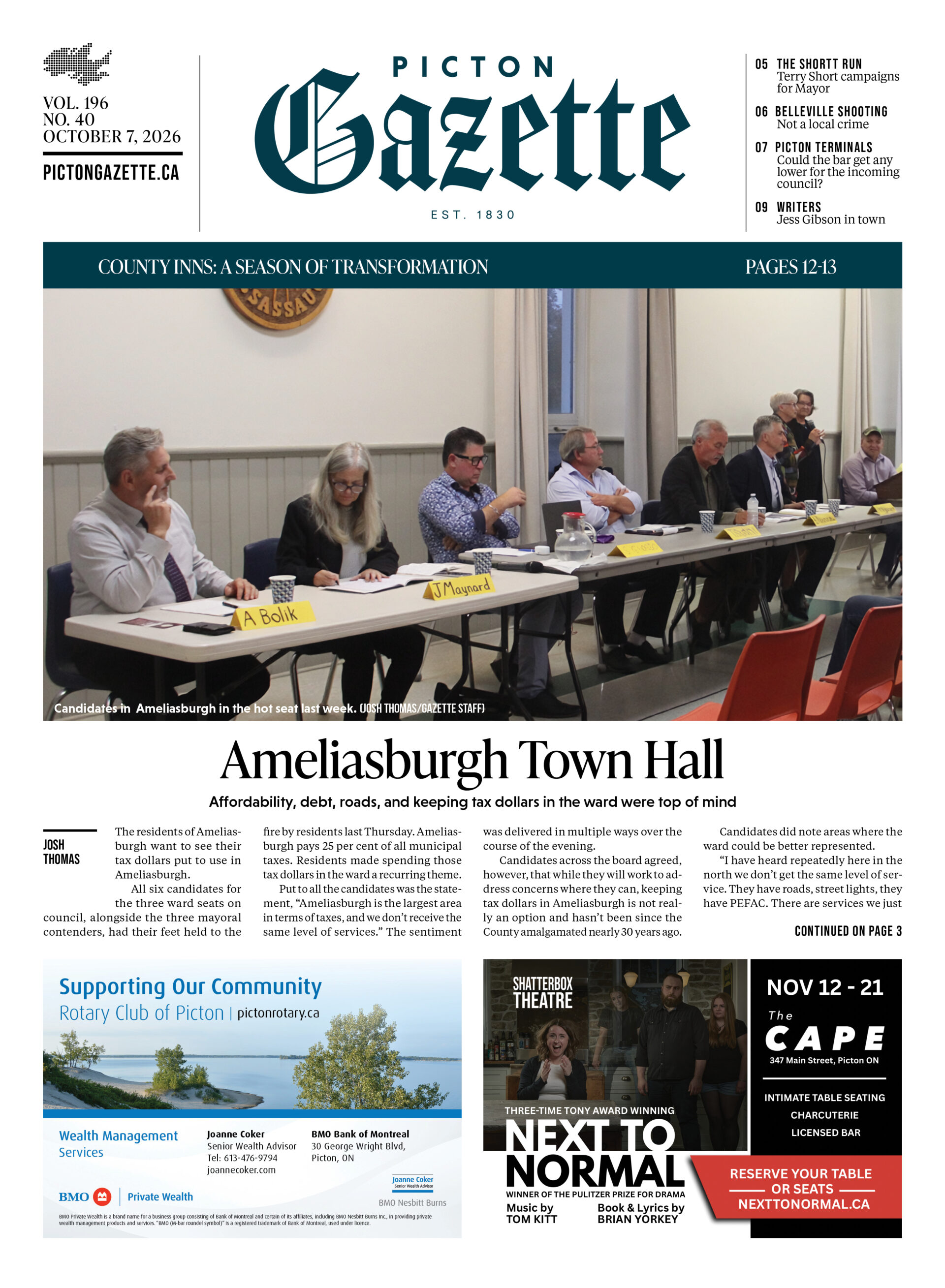
See it in the newspaper