Canada’s oldest weekly newspaper
© 2026 The Picton Gazette
Since 1830


 24° Mostly Cloudy
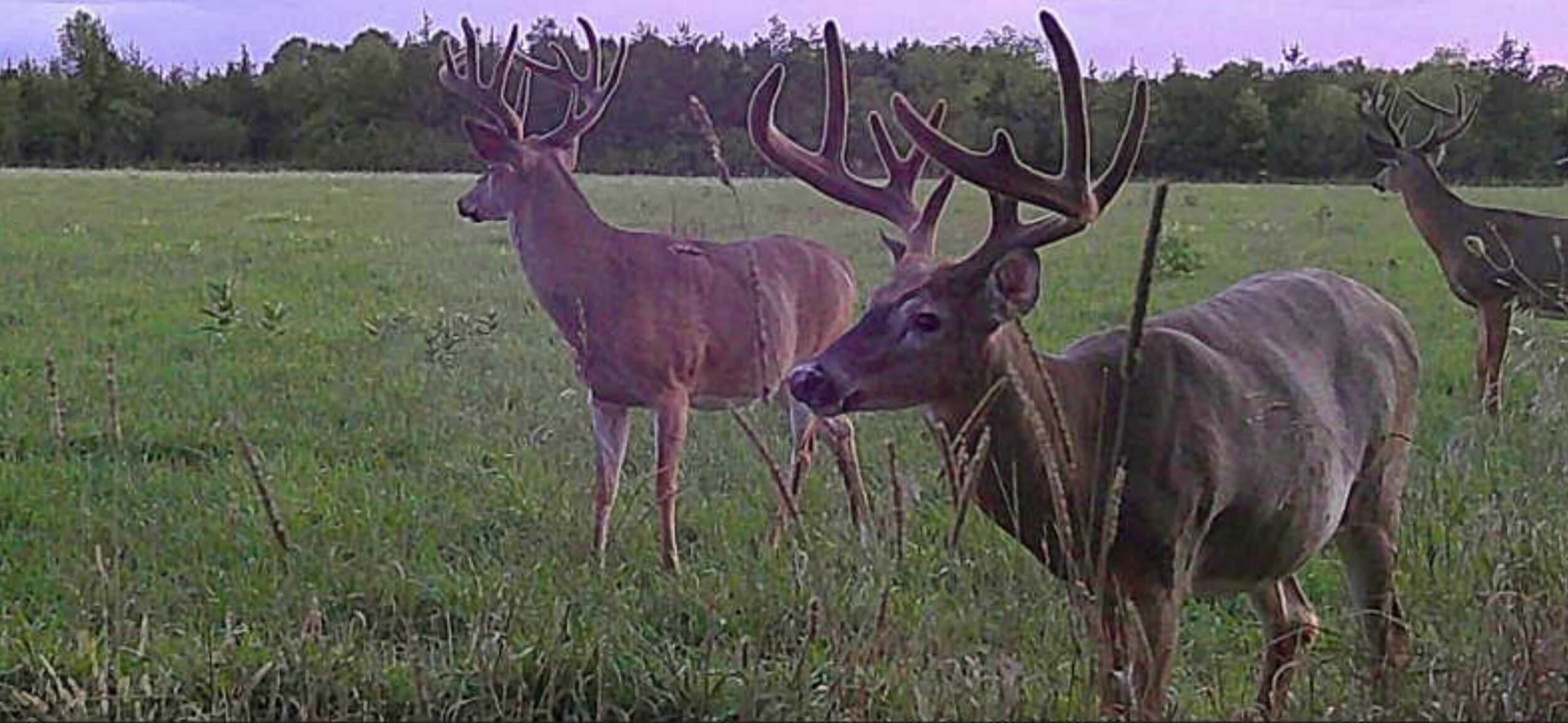 Deer Trail Cam image (Courtesy Matt McMahon)
“Through the month of October, I hunted something like 65 hours, you know, it was basically every chance I got,” says Matt McMahon. “I truly do live for deer season.”
In early November, Mr. McMahon heads to a hunting camp on Crown land in the Ottawa Valley, where two groups of seven men gather for fresh air, banter, and camaraderie straight out of a Howard Hawks movie.
“It’s the stories, it’s the memories. It’s something as simple as coming back from a hunt and talking to the other guys you’re at the camp with about what you’ve seen.
“It’s not about individuality. It’s group success. One guy in the camp gets a deer, we all get a deer.”
Mr. McMahon is a fourth-generation hunter. He started learning at five years old from his father and grandfather what would come to be his life’s calling. He lost his father when he was 17. Every return to the camp grounds him in the generational continuum.
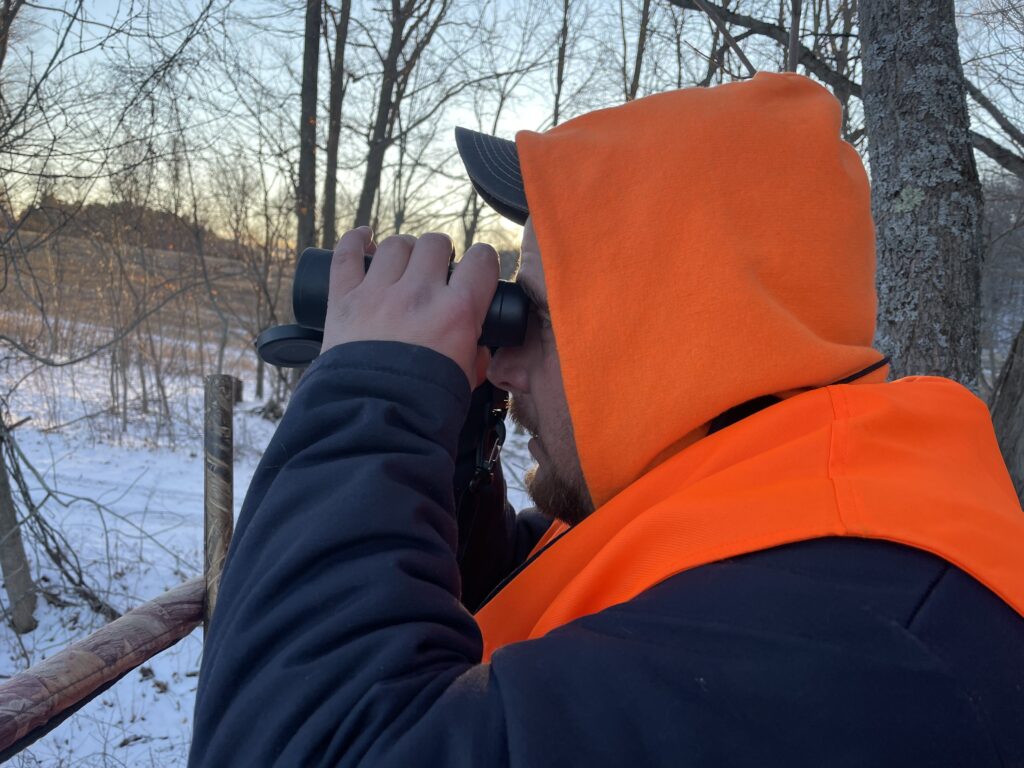
“I feel an extreme, deep connection when I go because it was something I did with my dad and it’s something I’m going to do with my son. My son’s going to come next year at six years old.”
Leaving the County for deer season is a County tradition. Until the 1980s, it was the only option.
“There are a number of people in Prince Edward County who have hunted deer for generations and so they had to go off of Prince Edward County because there wasn’t any deer season,” says Dan VanExen, a retired Conservation Officer who teaches both the Ontario Hunter Education Course and the Canadian Firearms Course.
As in other parts of the province, licensed hunters in Prince Edward County are permitted to bow hunt deer from the beginning of October through the end of December. But unlike most of the province, where a two-week firearm deer season is in November, the County has a controlled deer hunt for just one week in December.
“The biggest concern wasn’t the number of deer hunted, but the number of hunters,” says Mr. VanExen.
“As hunters, we are the greatest conservationists because we want them to succeed. We want them to be around for generations to come. We want them to have what they need to survive.”
—Matt McMahon
Most of the land in Prince Edward County is privately owned. Regulators wanted to prevent trespassing from an influx of hunters. Those who own at least 50 acres of land are automatically permitted to join the controlled deer hunt, otherwise, they must enter a draw.
The rules around harvesting are the same for everyone, bow or firearm, controlled or not: one deer tag per person. Hunters who have used their tags can also go out party hunting in a group of two or more, so long as the harvest does not exceed the number of tags held by the group.
For Mr. McMahon, using his tag takes anywhere between a half hour to several weeks. His family eats venison two to three times a week all year long.
On one of the coldest days of the December hunt, I sat with Mr. McMahon in a tree stand overlooking a field of wheat and raspberry bushes, as he recounted the harvest of his life.
In 2021, he began tracking a one-and-a-half to two-and-a-half-year-old buck on his trail cam, knowing by its size that he had something special. He named him Eastwood, because he “walked like an old cowboy.”
By October 2025, Eastwood had grown into a mature 11-point buck, clever and quick.
“I owe everything I’ve learned this year to him,” Mr. McMahon says. “It wasn’t just a deer. People don’t understand the intelligence of this animal.”
Although Eastwood had made appearances on the trail cam all summer, by the time the October bow hunt commenced, he was nowhere to be found.
“It goes on and on, through Thanksgiving, and it’s just this trudge of ‘I love this sport,’ ‘I love this game,’ but it’s getting to the point where I’m not seeing anything, but I keep going.”
When he saw Eastwood again, he was ecstatic.
“The church bells are ringing, my favourite son’s come home,” he says.
“It doesn’t matter whether I get him, I’ve seen him.” But Mr. McMahon did get him.
“Literally every moment along the way through this journey is flashing through my mind like a slide show.”
The Ministry of Natural Resources places either tag limits or daily limits on the number of animals harvested for any given species.
“As hunters, we are the greatest conservationists because we want them to succeed. We want them to be around for generations to come. We want them to have what they need to survive,” Mr. McMahon says.
He emphasizes that hunting mature bucks is not just about chasing antlers. Harvesting older bucks after they’ve bred keeps them from inbreeding, he notes, and maintains a healthy bloodline.
In line with the principle of conservation, hunting seasons are scheduled to protect natural lifecycles.
“Most hunting seasons are fall and most animals are born or hatched in the spring,” says Mr. VanExen.
Where there are exceptions, further limitations follow. During the spring turkey season, for example, you can only hunt the predominantly male bearded turkeys, while the hens are left alone to nest.
Conservation and safety are the twin pillars of the Hunter Education Course. In addition, hunting with a gun requires completion of the Canadian Firearms Safety Course. Each course can be completed in 8-10 hours followed by written and practical tests.
Budding hunters as young as 12 can complete the education course, but Mr. VanExen says he’s had students into their seventies.
The course, he says, offers “broad introductory knowledge.” But ethical hunting requires precision, and that takes practice.
For those who have never set foot on a gun range or a hunting camp, the idea of hunting can only conjure cultural touchstones, anything from Duck Dynasty to Rabbit Fire. The real-world practice, to the outsider, can incite fear and judgement.
“That’s the biggest misconception of hunting. That we’re just a bunch of redneck murderers,” says Mr. McMahon.
At the other extreme, hunting has a reputation as an elite, exclusive, and genteel sport—the preferred pastime of indolent aristocrats. The County’s own Nicholson Island is a private pheasant-hunting preserve veiled in mystery. It is rumoured to have hosted the likes of Bing Crosby, Mickey Rooney, and Jack Lemmon.
Even within hunting circles, an idealized image of toughness obscures the complex emotions hunters traverse.
“I don’t wear my camouflage when I’m not hunting but I wear a camouflage hat, and everybody asks the big question: ‘did you catch a deer?’ And you know, when you’re a hunter, it’s like, ‘oh yeah I caught one right by the antlers’.”
“It’s not about the killing,” he adds. “The killing is just a very small, small part of the whole experience of hunting.”
Mr. McMahon says that he feels remorse every time he harvests a deer. He embraces the essential pain of taking a life.
“That’s something that’s not talked about,” he says, adding, “if there ever comes a day when I don’t have that feeling, I’d probably give it up.”
The common pull for hunters, Mr. VanExan notes, is not the chase, but “that opportunity to be out interacting with nature.”
“Harvest is almost a bonus.”
Mr. McMahon often trails off at the incomprehensibility of his love for nature.
“You’re out on a lake and there’s just a whole huge raft of ducks flying around, the sky is black with birds. I have too many stories like that to tell,” he says, pausing thoughtfully.
“Maybe my favourite story is just that hunt season coming. And the next hunt season. I get to relive all these moments over again. Everything about it is my favourite thing about it.”
See it in the newspaper