Canada’s oldest weekly newspaper
© 2026 The Picton Gazette
Since 1830


 24° Mostly Cloudy
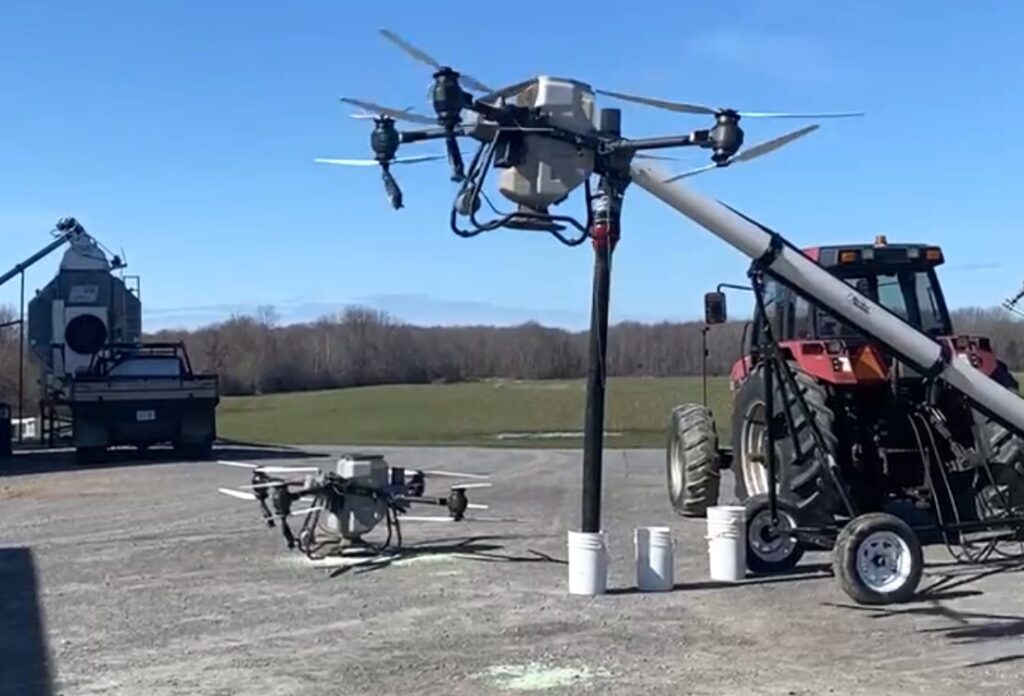 A drone takes to the sky over an Athol ward farm last week. Drone spraying is a new tool farmers are using when weather won’t cooperate. (Supplied Photo)
After one of the longest winters in recent memory, local farmers are eyeing planting plots and wondering when the high ground might be ready for cultivation. Springtime preparation is paramount for a strong growing season.
But while farmers are watching the weather and looking for tilling windows, input costs and commodity prices are rising. Will expected yields and prices per bushel meet the cost to plant, fertilize and harvest a crop this year?
They might — if the cost of fertilizer and diesel fuel weren’t through the roof.
Nitrogen-based products, such as urea and anhydrous ammonia, are seeing massive increases. Fertilizer is now priced 40–50 percent higher than it was last year. A tonne of anhydrous ammonia cost around $700 last year. Now it’s over $1,000.
As Soil and Crop Association board member and Ameliasburgh farmer Mark McFaul notes, “it all traces back to what’s going on at the Strait of Hormuz. Like fuel, the world needs fertilizer to grow the food needed to sustain it, and it’s very much a global market.
“Agribusinesses will source the cheapest fertilizer in the world that they can; any disruption in the regular global supply chain will drive up costs,” Mr. McFaul told the Gazette.
Likewise, in January, a litre of dyed diesel cost farmers $1.28. Prices have fallen slightly in the last few weeks, but in March, diesel peaked at around $2.19 per litre. As of this writing it was still high: $1.82.
“I try to have some optimism; in an inflated market being driven by high oil prices, agricultural commodities tend to do ok because there’s some stability there,” Mr. McFaul added.
Soybean futures on the Chicago Board of Trade were at $11.60–$11.80 per bushel this week, while corn was at $4.18 to $4.62. While not at their high, at those prices, County farmers might still make a profit.
Mr. McFaul notes the futures markets on soybeans and corn aren’t terrible at this point in the season, particularly when considering the dollar’s current value against the U.S. greenback.
“I’m hopeful we will see the price go up incrementally with the input cost hikes — but of course that doesn’t help the end consumer.”
As for the weather, some wheat farmers are worried winter is lingering too long. The Ontario Ministry of Agriculture suggests farmers growing winter wheat apply the first nitrogen by mid-April.
“We are past that. You can tell just by looking at the fields, the wheat isn’t as green as it should be, so the delay is costing us yield,” McFaul said. “We aren’t in big trouble yet, but we need some dry days so we can get the sprayers on the land and get to work.”
Some local farmers are taking to the skies to drop an initial dose of nitrogen on their wheat. Wood Drone Service out of Lindsay was one aerial outfit spreading urea on County fields last week.
Agriculture spraying drones are a revolutionary crop management solution growing in popularity. Billed as a high-precision, cost-effective alternative to traditional ground-based sprayers, Ag Drone systems use centrifugal nozzles and GPS-guided flight to deliver pesticides, herbicides, and fertilizers with minimal waste.
They are especially helpful when the weather isn’t cooperating with spraying windows.
“Obviously, there’s added cost when compared to regular field spreading, but if an early application can net you an extra bushel or two per acre, it pays for itself,” the farmer added.
“It’s a new process, so some farmers are taking the wait-and-see approach.”
See it in the newspaper