Canada’s oldest weekly newspaper
© 2026 The Picton Gazette
Since 1830


 24° Mostly Cloudy
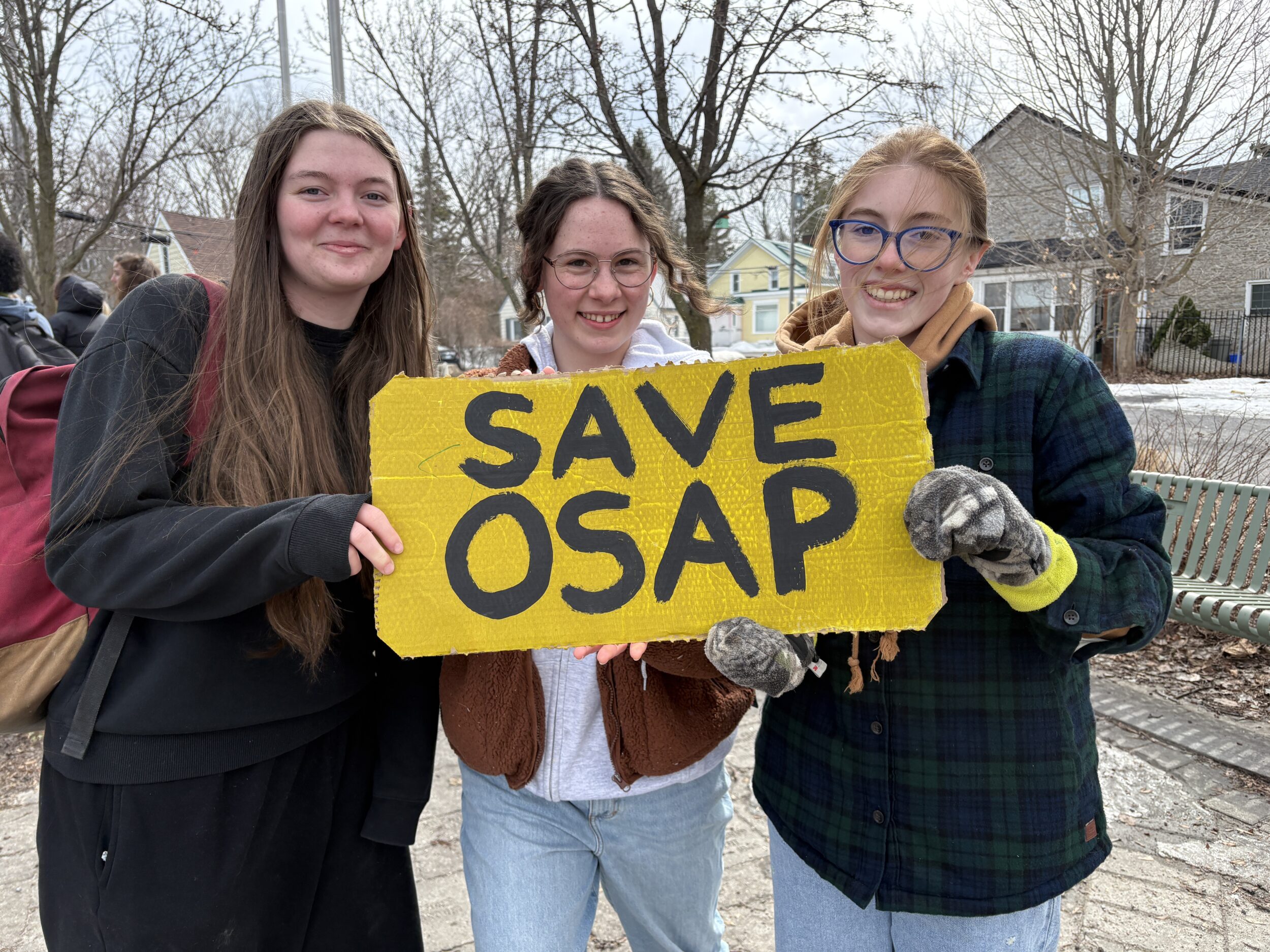 Suri kelloway, Norah Venslovaitis and Savannah Stevenson were at the Cenotaph last Thursday along with 50 of their friends to protest Premier Doug Ford’s cuts to the provincial portion of the Ontario Student Assistance Program. Most of what used to be grants will now be loans that must be
repaid.
Karen Valihora/Gazette Staff)
Suri kelloway, Norah Venslovaitis and Savannah Stevenson were at the Cenotaph last Thursday along with 50 of their friends to protest Premier Doug Ford’s cuts to the provincial portion of the Ontario Student Assistance Program. Most of what used to be grants will now be loans that must be
repaid.
Karen Valihora/Gazette Staff)
PECI students skipped afternoon classes Thursday to bring attention to the Ford government’s changes to the provincial portion of OSAP, the Ontario Student Assistance Program.
Starting in September, the Ford government will shift the proportion of loans and grants that make up the provincial portion of student assistance packages. Currently, up to 85 per cent of the financial aid students receive from the province comes in the form of grants that do not need to be repaid. The remainder comes from loans.
Under the changes, only 25 per cent of the provincial portion of OSAP funding will come from grants, with the rest provided as loans.
Students say the changes will either keep them out of post-secondary education altogether — or saddle them with debt for decades to come.
OSAP is a financial aid program that gives money to students attending university or college to pay for school. It is funded by both the province and the federal government, but the formulas that determine how much of any given student’s funding is federal and how much provincial are not clear.
Premier Ford’s announced cuts will only affect the provincial portion of OSAP grants. Generally, about 40 per cent of OSAP funding comes from the province. Federal grants are not changing.
Nonetheless, it’s a direct hit to Ontario students. The reduced grant-to-loan ratio comes at the same time as a nearly decade-long provincial cap on tuition increases comes to an end.
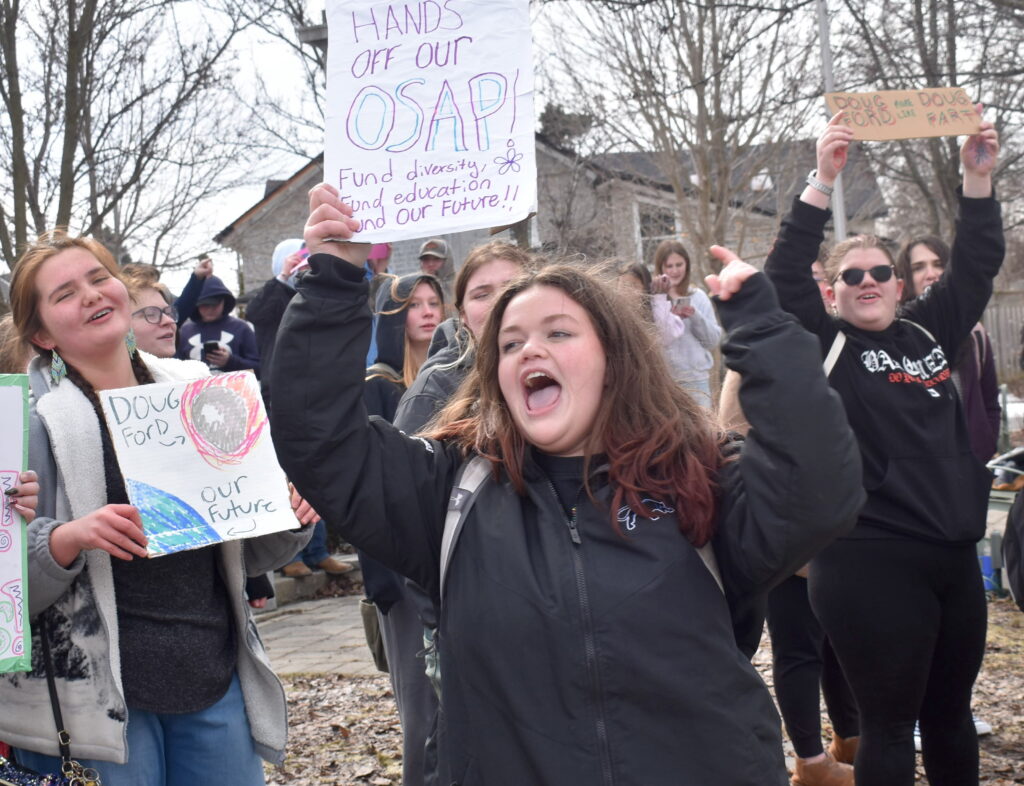
About fifty sign-carrying Panthers walked from PECI to the Cenotaph on Picton Main Street, loudly decrying Ford’s funding cuts. The protest echoed similar gatherings in small towns and larger cities across Ontario last week.
In February, Ontario’s Colleges and Universities Minister Nolan Quinn announced a much needed $6.4 billion funding injection into the province’s struggling higher education sector. Ontario boasts the lowest funded higher education system in Canada. The new money will increase the system’s operating funding to $7 billion, a 30 per cent increase.
The lifting of a 7-year tuition freeze will allow up to a 2 per cent increase per year for three years, then 2 percent or the three-year average rate of inflation, whichever is less, in the years following.
Sayak Sneddon-Ghosal, President of the Ontario Undergrad Student Alliance, said he was encouraged by the Province’s investment and the incremental tuition increase.
But the OSAP changes will disproportionately hit underpriviledged students from a wide range of socioeconomic backgrounds.
As student loans increase to 75 percent of the provincial funding allocation, future graduates will face greater financial strain as they enter the workforce.
According to the most recent OUSA survey, 79 per cent of students anticipate their debt would be somewhat or very burdensome after graduation. And that was under the previous OSAP framework.
“To alleviate the immediate debt burden, OUSA recommends the provincial government implement a no-interest student loan program modelled after the federal initiative to remove interest on all student loans,” Ms. Sneddon-Ghosal said in a statement. “Additionally, to further support future graduates, the provincial government should extend the OSAP loan repayment grace period from six months to at least two years.”
Both PECI’s Thomas Rice and Audrey Maracle are student trustees on the Hastings and Prince Edward District School Board and helped organize the PECI portion of a province-wide protest.
Mr. Rice said he hoped local residents would take note of the students gathered at the Cenotaph and listen to their concerns.
Ms. Maracle explained her brother is attending college to study a skilled trade and relies on OSAP to fund his post-secondary pathway. Changes to the OSAP program could have devastating, long-lasting effects on students in the middle of their post-secondary studies.
“Our future will be negatively impacted. Some of us will put off going to college or university because we can’t afford these high-interest student loans. It’s affecting all students, especially those coming from the County, which isn’t exactly a high income area,” she said.
“We want to seek higher education and become successful adults whether that be in trades, college, or university. These changes are making that path completely inaccessible to most low and medium income students because you can’t pay off 75 per cent of your education loans.”
Councillor Kate MacNaughton, whose daughter is applying to universities for next fall, said, “it’s just another hit for low income students.”
“The Ford government seems to always punch down onto those who can afford it the least. This time, it’s actually a one-two punch that blows their 2019 cuts out of the water. It tells young people who don’t have Doug Ford’s personal wealth and privilege to limit their dreams and capacities to what he thinks is acceptable.
“The student debt crisis in the USA should be the cautionary tale and we’re moving in that direction.”
See it in the newspaper