Canada’s oldest weekly newspaper
© 2026 The Picton Gazette
Since 1830


 24° Mostly Cloudy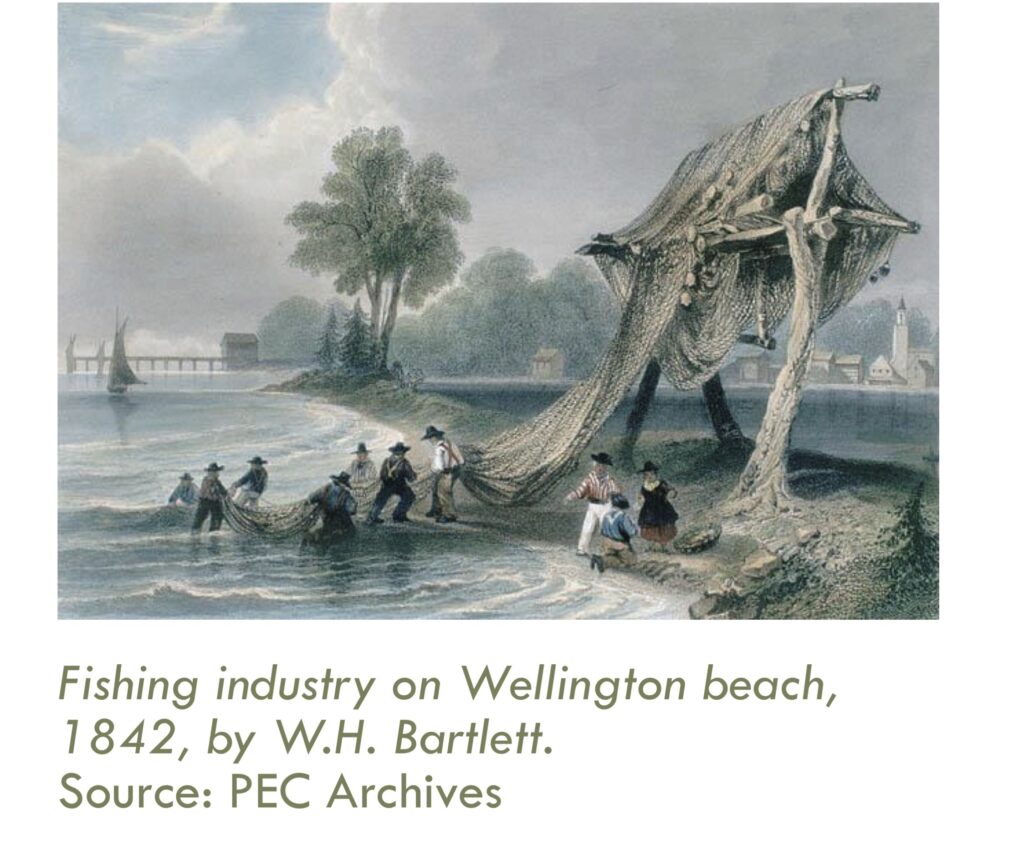
As the Drake Devonshire looks ahead to an expansion that will more than double its accommodation capacity, in a Flashback February talk last week Ernie Margetson invited a crowded room at the Drake to look back, to a story of radical transformation and enduring history at 24 Wharf Street.
From the very early days of the village of Wellington, Wharf Street was the centre of the town’s economic engine.
A shipping hub, an iron foundry, and now the Drake Devonshire, the lakeside location has always been primed for activity.
Mr. Margetson opened his talk with the earliest known image of the location, a sketch by British artist William Henry Bartlett.
A shipping hub, an iron foundry, and now the Drake Devonshire, the lakeside location has always been primed for activity.
Upon his journey to Canada, Bartlett wrote, “travel here is the strangest mixture of fun, danger, inconvenience, good living, and starving.”
A list that describes life in the County to this day.
In the background of the sketch, you can see the wharf and the grain storehouse, owned by the prosperous Wellingtonian Archibald McFaul.
McFaul’s operation was “one of the biggest ports on Lake Ontario,” Mr. Margetson noted. “One of the most dangerous, but one of the busiest.”
The water levels fluctuated and the wharf was often destroyed by storms. “You will often see remnants of it today,” Mr. Margetson said.
McFaul died around 1860 and the property went through a few hands before landing with Townsend G. Terry, who in 1864 opened the County’s biggest iron foundry of its day.
The foundry is in the bones of the building that stands today. At the time, it was simple and sturdy: two-storeys, with five bays of seven to eight foot casement windows. And four layers of brick.
“Brick helped it survive. You think of the story of the three little pigs,” Mr. Margetson quipped. “I think that’s why the building is there today, because it was so robust.”
Both a foundry and a blacksmith shop, it produced both cast iron and wrought iron. It supported the County’s growing wheat production by supplying farmers with iron plows to harvest up to two acres a day.
The industry turned over again with the introduction of the railway in 1879. Suddenly, the County had rapid access to supplies from bigger foundries in big cities.
“By the late 1800s most foundries were done, blacksmiths as well,” Mr. Margetson said.
After passing through the hands of David Clinton, and his son Bill, the property landed with W.P. Niles in 1905.
Niles was “quite a character in Wellington.” He left as a young man to travel throughout North and South America, working for a silverware company. When he returned to settle down, “things were changing and he took advantage of the situation,” Mr. Margetson noted.
With business booming, Niles hired prolific Wellington Architect W.W. Fitzgerald to transform the defunct foundry into a beautiful lakeside residence.
“What a built legacy he left,” Mr. Margetson effused.
It wasn’t long before the stately residence became a commercial venture. After W.P. Niles’ death the house went to his nephew Norman Clinton, who opened it up as a tourist accommodation in 1917.
The house oscillated between different iterations of accommodations and retirement homes before becoming the Devonshire Inn, and, in 2012, the Drake Devonshire.
Mr. Margetson consulted on that project as an engineer, and was wrapped up in the vision for two full years. “It was a complicated job,” he says, with such feats as a cantilevered dining room overlooking the lake.
The renovations occurred before downtown Wellington was designated a Heritage Conservation District under the Ontario Heritage Act.
“I think that what we did recognized a part of the heritage that was preserved, incorporated it, and added to that.”
While the Inn has been modernized, heritage features include doorways, its banister, brickwork from the original foundry, and W.W. Fitzgerald’s stucco.
On a clear day, cocktail in hand, you might even glimpse a wayward remnant of the old wharf floating toward you on the lake.
See it in the newspaper