Canada’s oldest weekly newspaper
© 2026 The Picton Gazette
Since 1830


 5° Mainly Clear
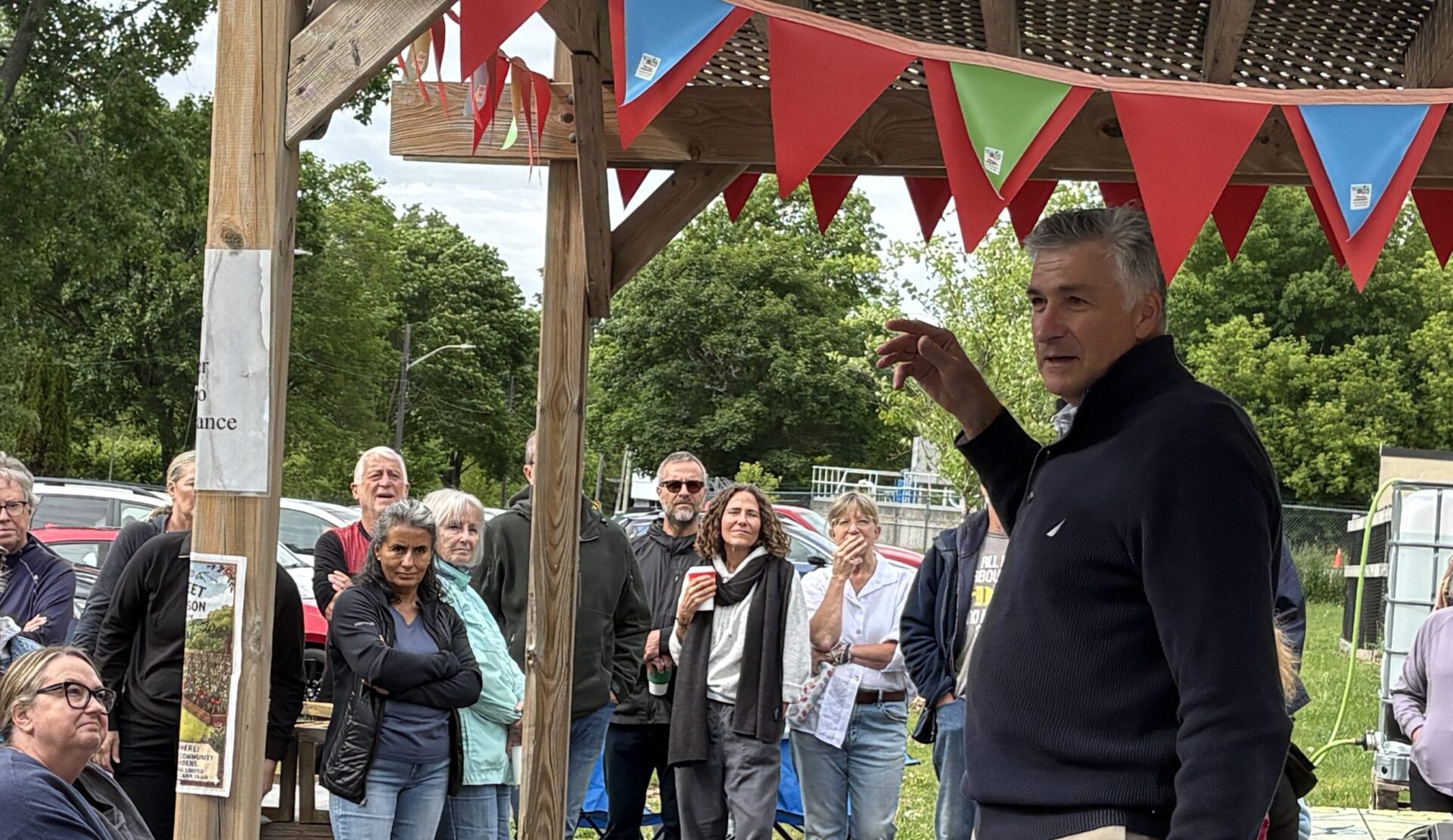 Ernie Margetson launches his Mayoral Campaign at Delhi Park with about 50 people in attendance. (Karen Valihora/GAZETTE STAFF)
Mr. Margetson kicked off his Mayoral campaign with a talk at Delhi Park last week hosted by Picton Community Gardens and Friends of Delhi Park. About 50 people gathered on a glorious afternoon in front of neat rows of community garden beds, across from the proposed Prince Edward Pickleball courts on the old baseball diamond.
The location couldn’t be beat.
Try as he might to keep things general — Mr. Margetson opened with a brief summary of his career as an architect and a nod to the importance of Delhi and other parks as “the centre of their communities”— the current politics of the park were there before him.
His earnest hope that Delhi “can be everything for everyone” could not avoid becoming a political statement.
“We don’t feel there has been adequate consultation about the location of the pickleball courts,” was among the first of the many vexed questions Mr. Margetson had to field on his first day out.
In response to this, he noted Council’s 2024 decision to designate the courts a project of community interest. He then pointed to York Street, the playground, the community gardens, and the dog park, and stressed Delhi was already and should continue to be a multi-use park.
“We need to work out conflicts between uses in close proximity,” he said to a round of applause.
Another question tackled the matter from a different direction. Victoria Taylor, a landscape architect and a principal consultant in the development of the community connections plan for Delhi, asked, “How do you feel about master planning?”
“I believe we need a master plan for Delhi Park,” she continued, “which will offer an opportunity for community consultation about what should happen in this space, and allow for studies of noise impacts, required parking, lighting, the tree canopy, lack of running water and washrooms, and consider possible other locations for the pickleball courts, such as the Fairgrounds.”
But Mr. Margetson didn’t agree we need more plans, or consultants.
“I’m going to be up front. I don’t want to spend a lot of money on consultants and studies. We need a vision for the expansion of the park, a plan for implementation, we want to use it in future to connect neighbourhoods with a network of trails and paths, but I don’t want to overly formalize the place.
“Sometimes it’s best if you come across a trail by accident.”
Mr. Margetson also asserted that the Heritage Master Plan for the Fairgrounds did not allow for pickleball, to explain why the site was not being considered.
After the talk, Ms. Taylor noted to the Gazette, “the 2021 Fairgrounds Heritage Master Plan mentions pickleball three times, each time to support the inclusion of recreation and pickleball courts in balance with agricultural uses.”
The exchange, and others like it, suggested that Mr. Margetson’s key strengths, his idealism and directness, are going to be tested in a County grappling with increasingly complex issues both large and small.
In response to the question, “How do you plan to address the serious divide on Council — sometimes it seems like two opposing teams?” Mr. Margetson advocated “respect and communication.” Perhaps realizing those old standbys were not going to be enough, he was not afraid to take a stand.
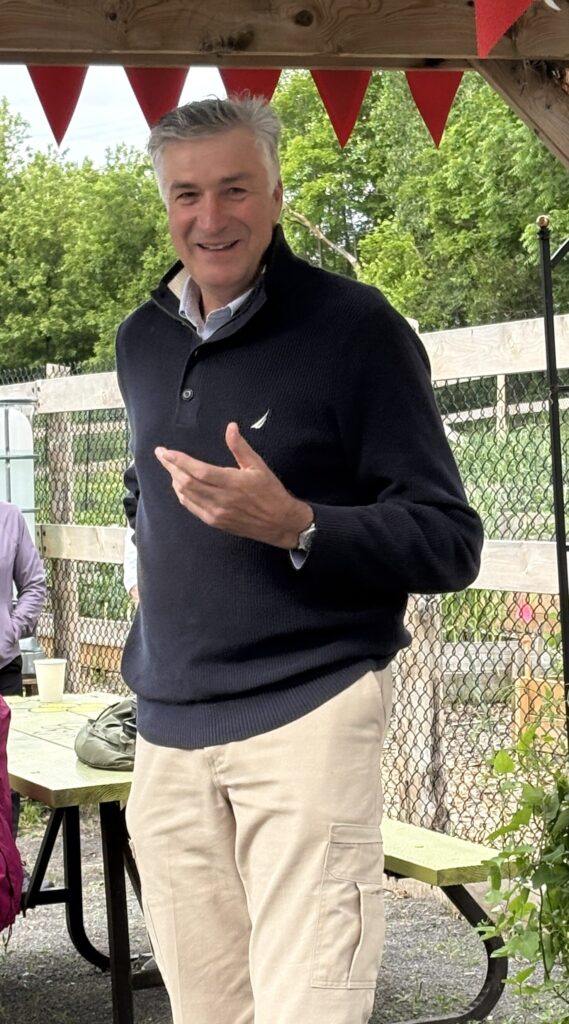
“If that doesn’t work,” he said, fewer councillors might make it easier to “create a good working group.”
“I can see Council being reduced in size — but it’s important to go through a public process to do that.” Amalgamating wards, he said, would be more efficient.
When asked whether he would warn councillors proceeding with a conflict of interest, “I would refer the matter to the Integrity Commissioner,” he said. “Both integrity and avoiding conflict are very important to me.
“It’s very important that you not act with a conflict of interest: there’s pecuniary and non-pecuniary conflict of interest, and then there’s just doing the right thing.
“Hopefully that example will rub off on other councillors.”
The Council Code of Conduct notes that councillors must avoid conflicts of interest, but it has been called legally unenforceable by the current Integrity Commissioner.
Another questioner asked whether “the municipality has done all it can when it comes to Picton Terminals? Are there any other options to be pursued there?”
“The issue has expanded over time,” noted Mr. Margetson. “It has gone from being a shipping terminal, receiving bauxite and salt, to a quarry shipping aggregate.” He noted issues around lights, noise, air and water pollution, and the need to determine “what the digging is for.”
Referring to what looks like negligence at the MNR, he noted, “the municipality has been dealing with a system that has not been as active as it could have been” in monitoring the activities at the Terminal.
Another question concerned the County’s waterworks plans. “It will be the largest expenditure the County has ever made,” the questioner noted. “It’s not just a Wellington issue, but a County-wide issue.”
Mr. Margetson was ready for this one. “I’m waiting for the results of the waterworks plants capacity audit, which is due in August,” he began.
A key question of that audit is whether current infrastructure can be extended in the short term. Both Picton and Wellington WTPs have very limited capacity. Picton’s Chimney Point water treatment plant is nearing end of life. It can service about 1000 more homes; of that number, about 600 units are already allocated to developers; others are competing for the remaining 400 units.
In Wellington, while there are about 200 units of water servicing capacity remaining — all allocated to Kaitlin’s Cork and Vine subdivision — there are just 5 for wastewater.
That means no development at all can take place in Wellington without either a new or refurbished plant.
But Mr. Margetson has his own plan. “We need to use our existing plant capacity and infrastructure to build up some Development Charges and [financial] reserves — the municipality will have to front-end some of the costs of new infrastructure. But I am hoping we can build up some reserves by relying on our existing infrastructure to pay for expansion.” Critics note, however, that it will cost millions to extend infrastructure even for a short term.
As for the regional water plant, which engineering studies suggest is a cost-effective alternative to building two new plants for 10,000 people, “I’m not convinced at this point that this is the way to go,” said Mr. Margetson.
Referring to a 2015 study that suggested simply relocating the Picton WTP intake to a location further out into Picton Bay, he said, “a regional plant would require building a water main all the way from Wellington to Picton. Those costs need to be considered.”
Mr. Margetson then pointed to a 2025 Watson & Associates study that suggested a growth rate of 150 to 180 homes a year. “We are nowhere near that,” he said. “We need to assess things, and use the available capacity in Picton and Wellington to issue building permits and get DCs going.”
The candidate stressed that competing priorities, for infrastructure, roads, and asset management, will require cuts. “Trying to determine our priorities” is his first priority. “We are moving in too many different directions; things are getting left behind. While honouring the County’s legal obligations, we need look at what we can do with the money we have; we cannot do it all.”
“It’s a challenge I’d like to take on, and I want to do a good job,” he said to warm applause.
In response to a question about how to engage young people in the County and entice them to stay, he said, “it would be nice to have some young people on Council, to be honest with you.”
See it in the newspaper