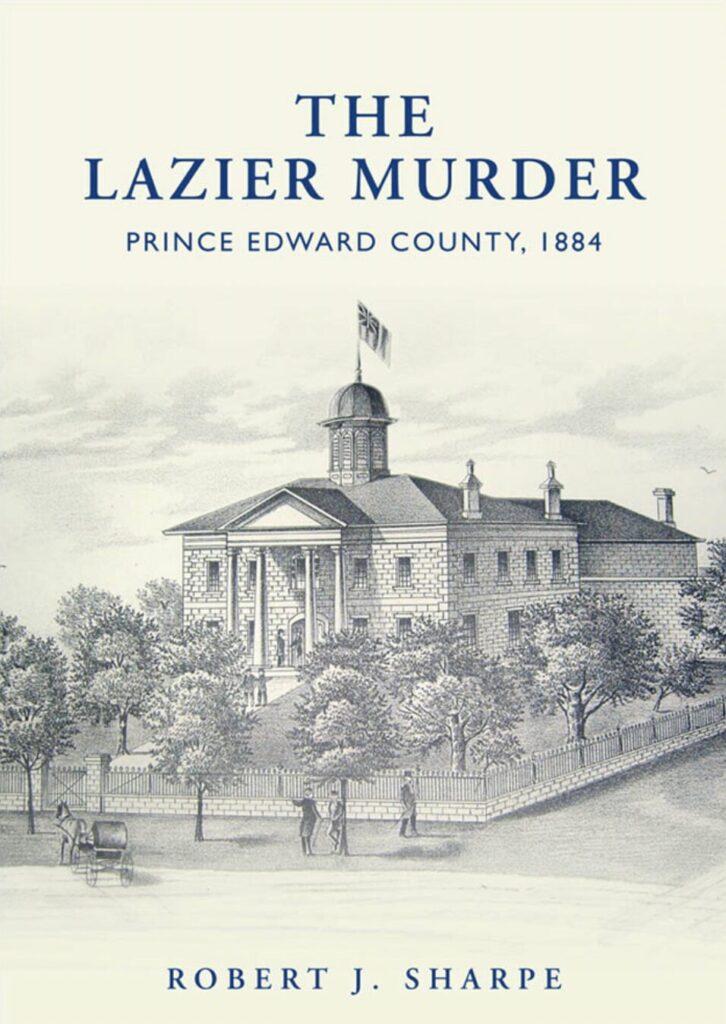
 Book cover of Judge Sharpe’s investigation.
The murder of Peter Lazier and the hanging of his alleged assailants is embedded in the collective memory of Prince Edward County. It is at once an illustrative moment in Canadian legal history, a study of mob mentality, and a whodunnit.
All of these elements were woven into a Flashback February talk last week by Robert J. Sharpe, a legal scholar and judge, and the author of The Lazier Murder: Prince Edward County, 1884. After writing other legal histories, he wanted to turn to a story he had grown up with and see what kind of material he could find.
In collaboration with History Lives Here’s Peter Lockyer, who presented the talk, Judge Sharpe adapted the book into a play performed at the Picton Court House in 2014.
Peter Lazier, a farm implement salesman, was shot in the heart one night while staying at the farmhouse of his wife’s uncle and aunt.
December 21, 1883 started as a very good day for Gilbert and Margaret Jones.
Mr. Jones had just been to Bloomfield where he was paid $555 in cash for a load of his hops.
In today’s dollars, the sum represents a good year for someone working in the trades.
December 21, 1883 started as a very good day for Gilbert and Margaret Jones. Mr. Jones had just been to Bloomfield where he was paid $555 in cash for a load of his hops. In today’s dollars, the sum represents a good year for someone working in the trades.
The streak of fortune ended that night when Mrs. Jones unwittingly opened the door to two robbers. In her panic, she brought Mr. Lazier out of bed first, followed by her husband who wielded an empty shotgun. Upon sight of the weapon, one of the robbers fired his pistol at Mr. Lazier.
A group of neighbours quickly rallied to investigate, trudging through the snow to follow tracks they believed would lead to the perpetrators.
They were also joined by the local constable, but at the time, Mr. Sharpe noted, “constables were basically volunteers. They weren’t trained in investigation methods.”
The zealous neighbours determined that the snow tracks led to the Thomset and Lowder homes. David Lowder was arrested, but the investigators determined that his brother George’s size eight patch-bottom boots more accurately fit the track marks.
At that point, Hugh McKinnon, the Belleville Chief of Police, stepped in to take over the investigation, only to hold steadfast to the dubious track marks as key evidence.
Mr. Mckinnon hailed from Hamilton with a “tough-on-crime” reputation; he had busted the Donnelly gang.
More than trying to uncover the truth, “he was trying to get the evidence to fit the theory,” said Mr. Sharpe.
The public was primed to be persuaded. In a relatively tranquil community where the list of known crimes included drunkness, horse stealing, and bigamy, murder was unheard of.
“The local people were out for blood,” Mr. Sharpe noted.
It didn’t help that the witness testimony was muddled, that the accused presented alibis, or that George Lowder’s boots were the most common size and type in the County.
It didn’t even help that Thomset’s defence counsel, D’Alton McCarthy, was one of the top lawyers of his time.
The jury, echoing public sentiment, came to a swift verdict that the men were guilty. The hanging on June 10, 1884 was as botched as their trial, leaving the men to thrash and kick their way to death.
While Mr. Sharpe couldn’t say whether it was a wrongful conviction, he could say, “it had the hallmarks” — a rushed trial, a roguish detective, and weak evidence.
The sober second thoughts of the community seemed to be those of doubt and remorse. As Mr. Sharp noted, in two subsequent murder trials, each with solid evidence against the accused, the defendants were acquitted.
A sunken stone in the Potter’s Field of Glenwood Cemetery is engraved with the words: George Louder hanged 1884 unjustly.
Though Mr. Lockyer noted it’s unlikely his remains were buried in consecrated ground, the inscription captures the legacy of a crime.
“We’re left with a great mystery,” he says.
See it in the newspaper
 12° Fog