Canada’s oldest weekly newspaper
© 2026 The Picton Gazette
Since 1830


 16° Cloudy
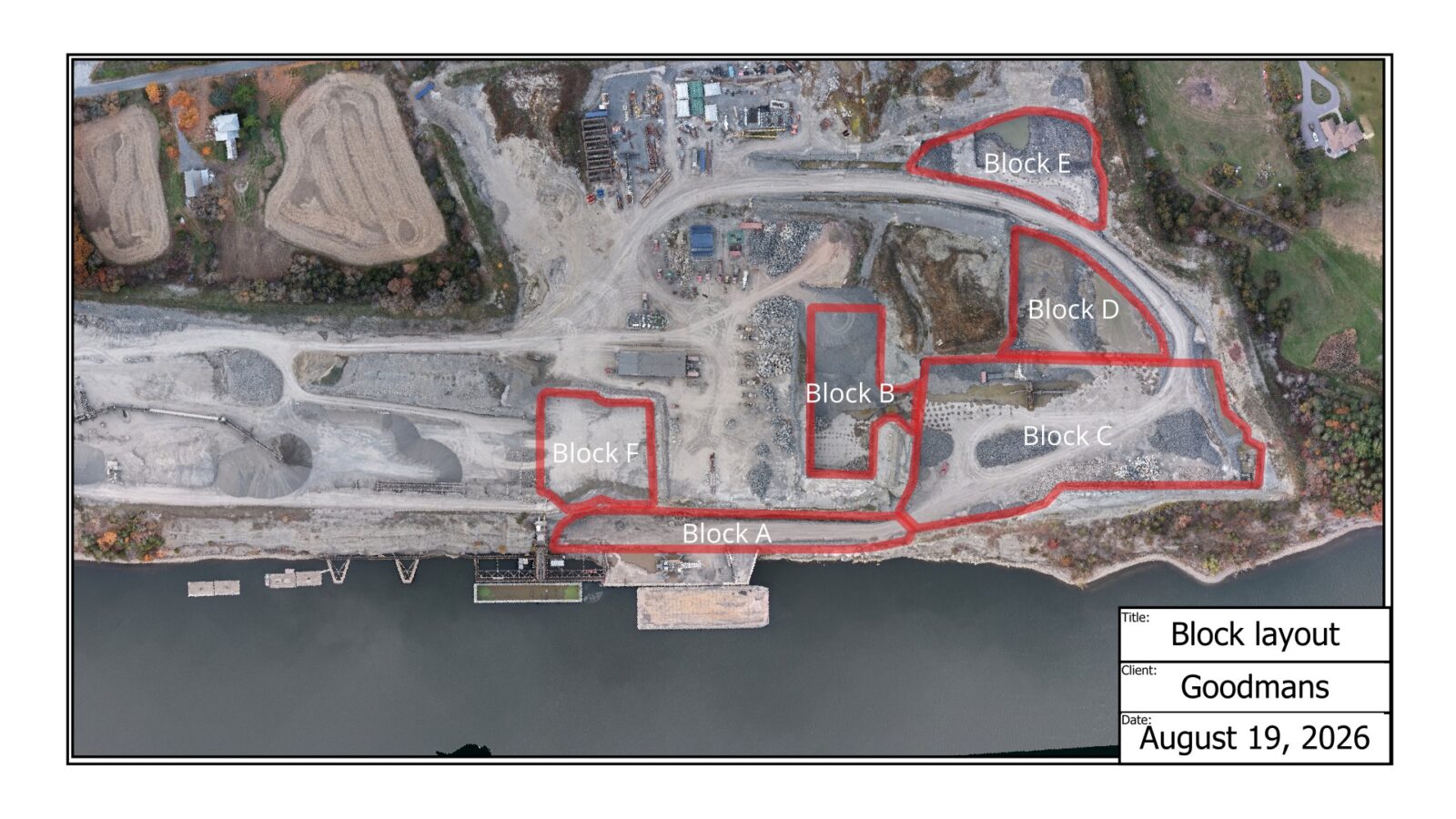 This photo, included in the court application, identifies six pits at Picton Terminals and the reasons supplied for quarrying them. Block A, the escarpment face opposite the dock, was excavated to build a road. Block B was excavated for a covered salt storage facility. Block C, the largest excavation, is a dock-level operations zone. Block D was purportedly excavated for stormwater management. Block E appears to be a settling pond. Block F was blasted in late 2024 for the installation of a grain terminal. In each case, say the applicants, quarrying went far beyond the stated purpose.
A lawsuit was filed on August 26 in Ontario Superior Court naming Picton Terminals’ owner ABNA Investments and the Ministry of Natural Resources.
Doug Pollitt, a mining engineer, filed the application on behalf of a group of County residents.
While it is the group’s second attempt to bring the Terminals to court for its alleged illegal rock quarrying, it is the first attempt to hold the Ministry accountable for failing to enforce the Aggregate Resources Act (ARA).
“As best we can tell, this is the largest unlicensed quarry in the MNR’s history. It’s important for all sorts of reasons that there be a judicial determination to that effect,” said Mr. Pollitt.
The suit seeks a court order declaring the property at 62 White Chapel Road “is being used as a ‘pit’ or ‘quarry’ as those terms are defined in the ARA.”
For a decade, the Terminals has justified the extensive quarrying of the site by saying it was for infrastructure development.
The ARA specifically excludes from the definition of a “pit” or “quarry” sites excavated for purposes of development.
The suit contends that the Ontario Superior Court ruling in the 2018 Save Picton Bay case established the legal non-conforming uses of the property, which do not include quarrying. Insofar as rock quarrying is ongoing, it argues, the Terminals is in contravention of County By-law 1816.
As for the MNR, the suit contends that, since 2016, it has allowed quarrying on the property for the purposes of building, yet the sheer quantity of rock removed from the Picton Bay escarpment is in total disproportion to any infrastructure development.
In the first, private prosecution filed in January 2025 by the same group, the Crown Prosecutor intervened on behalf of the MNR to dissolve the case, saying if any illegal quarrying had taken place at the Terminals, it had been permitted by the MNR and could be defended, therefore, as a case of “officially induced error.”
In an April, 2026 letter to the County, the MNR reaffirmed its position:
“MNR is aware of extraction activities occurring at this location. Based on information provided by the property owner from 2016 through 2025, along with observations made through site inspections, MNR concluded the excavation that occurred during that time frame did not constitute a quarry under the ARA. Our assessments have concluded the blasting and excavation activities were related to, and required for, ongoing infrastructure development associated with the shipping terminal. It is our conclusion that [the owners are] operating in compliance with the ARA.”
The applicants have assembled evidence — including Google Earth satellite images that document dramatic changes across the property over the past 10 years, and drone images used to create digital elevation models — to show “vast quantities” of rock — over one million tonnes — have been removed from the escarpment over the past decade.
They also show that the Terminals is only occasionally used as a shipping terminal and is not profitable in that capacity.
The suit contends that over the past decade, the owners of the Terminals, ABNA Investments and H.R. Doornekamp, entered into contracts for the sale of tens of millions of dollars worth of aggregate to be supplied to infrastructure projects across Eastern Ontario.
Contracts with ABNA Investments on the public record include the Ashbridges Bay Landform Project ($27 million), the Amherst Island Wind Farm Project ($18 million), and the Cherry Street Lakefill Project ($12 million).
The suit charges that “the minimum total value of aggregate sales [from Picton Terminals] between 2015 to 2024 was $62 million.”
The photograph accompanying this story was submitted as evidence to the court. It maps six different pits across the White Chapel Road property. Block A was excavated to build a road; block B for a covered salt storage facility. Block C, the largest excavation, is a dock-level operations zone. Block D was purportedly excavated for stormwater management. Block E contains a settling pond. Block F was blasted for the grain terminal.
“In each block,” the applicants argue, “the volume of aggregate removed is grossly disproportionate to the stated purpose, and, in several cases, the purported end use was either never constructed, constructed only years after the excavation, or prohibited by court order.”
For the grain terminal, approximately 150,000 tonnes of aggregate were removed over 8 weeks in 2024. At the same time, H.R. Doornekamp won a bid to supply the Hamilton Oshawa Port Authority with 150,000 tonnes of aggregate for the Randle Reef Remediation project.
“Soon after blasts for the excavation began, ships were observed taking on aggregate from the Property. Ship tracking data confirmed the cargo was taken to Hamilton Harbour.”
The suit further contends that the excavation of and sale of aggregate is ongoing, and that in the spring of this year, “rock was excavated, crushed to size and stockpiled, consistent with preparations for an upcoming contracted delivery of aggregate.”
Evidence suggests ABNA had contracted to supply aggregate for the Billy Bishop Airport expansion in Toronto.
See it in the newspaper