Canada’s oldest weekly newspaper
© 2026 The Picton Gazette
Since 1830


 15° Cloudy
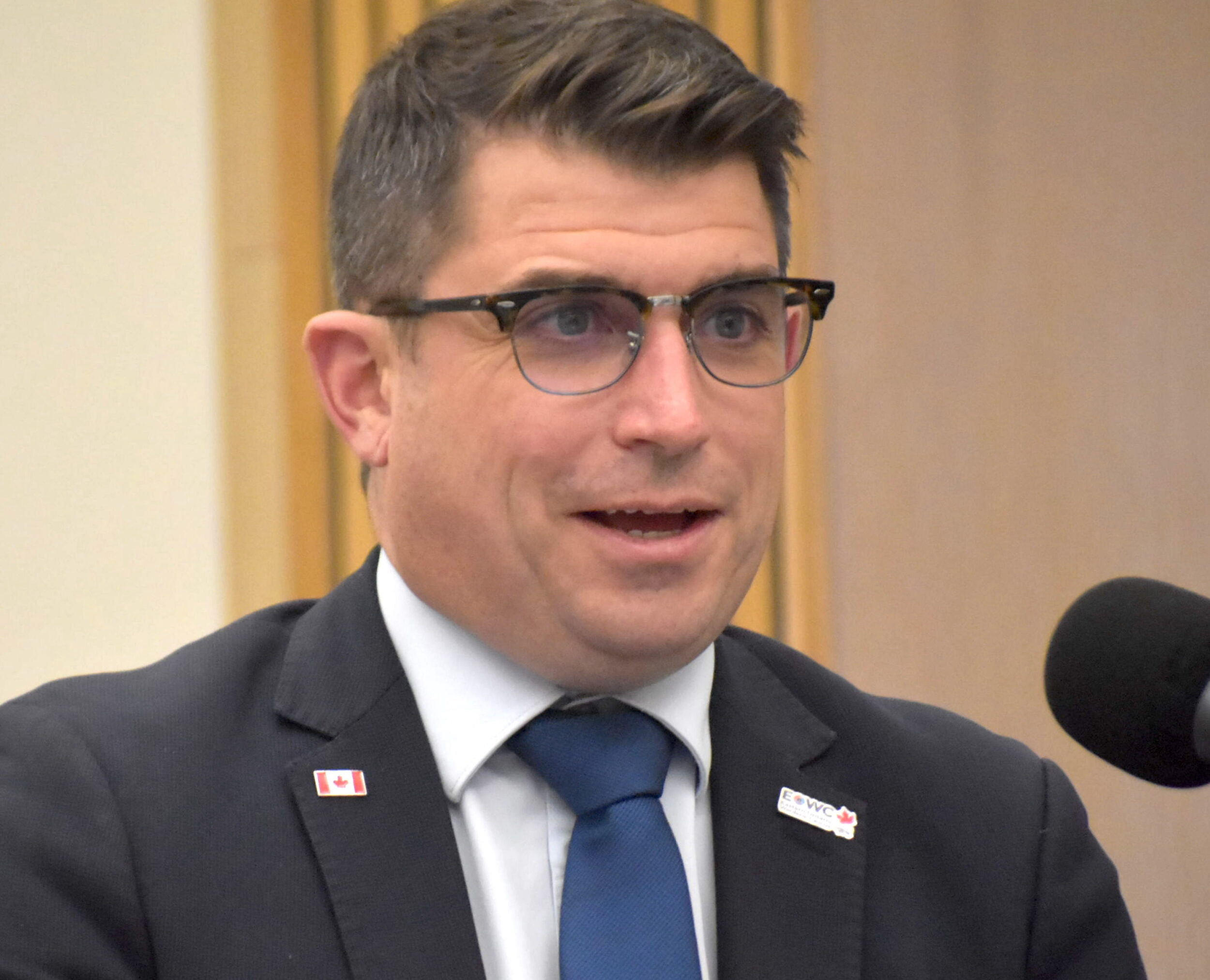 SEPH Board Chair Nathan Townend. (Jason Parks/Gazette Staff)
The South East Public Health Board is committed to consistent and equitable service across its new catchment area — while measuring its financial challenges. That was the message from Chair Nathan Townend to Council last month.
The Lennox and Addington Deputy Mayor has managed the amalgamation of health units in Quinte, Kingston and Brockville since the province called for greater regionalization.
“Harmonization” is the word Mr. Townend uses to describe changes across the new health unit. Amalgamation support funding from the Ministry of Health has buffered some of the short term pain. But an annual operational shortfall of $1.3 million will be covered through what the chair calls “prudent cost-saving measures.”
But Board of Health member and Sophiasburgh Councillor Bill Roberts notes provincial health funding has remained nearly static since 2018, capped at a one per cent annual increase.
After inflation, the province’s funding envelope has decreased by an average of 1.6 percent since the cap was introduced.
Per capita, Ontario consistently ranks at or near the bottom in Canada for health spending.
“In terms of funding gaps, when you look at 2026-27 for the Ministry’s entire healthcare envelope, you’re looking at a 1.6 percent cut below the inflation rate,” Mr. Roberts added. “Some serious advocacy needs to be done across the entire healthcare board.”
According to Chair Townend, “the deficit is sticky because it represents costs for which there is no direct funding. Unless dealt with proactively it will continue to accrue and balloon.
“The Board has yet to make strategic decisions about how to address this deficit, but expects to make those decisions in the future. For now, it has been important to daylight this financial constraint.”
Balancing Out Special Programs
Under the previous funding agreement between health units and the province, upper-tier and single-tier municipalities paid 25 percent of costs while the province paid a 75 percent subsidy. When units merged, Mr. Townend said, it was discovered some municipal levies were closer to 30 percent in order to ensure services were maintained.
“When we merged, we collectively agreed that in order to prevent cuts to service, or operational deficits, we would have to harmonize to the higher level,” he said. “This meant others had to have large levy increases up front to ‘catch up’.”
Part of the financial issue is that some Health Units are providing services that others are not.
For example, the Gazette recently covered a holdover Hastings and Prince Edward program of Public Health Nurses visiting secondary schools once a week in the Quinte area. That program isn’t delivered in Kingston or Brockville.
The drive to harmonize, and offer consistent, equitable public health to the 500,000 or so residents in the SEPH region may lead to the end of those weekly visits to PECI.
Harmonized levies are part of the equation, but they only balance part of the ledger.
Revised Ontario Public Health Standards (OPHS) are set to be released by the Ministry any day now and will guide harmonization. The standards determine the scope of work for public health. Chair Townend likened the OPHS to provincially mandated marching orders with funding tied to them.
“The challenge will be that the kinds of services and programs public health provides will need to be in line with this mandated scope of work,” he said. “Navigating these changes will be difficult on a number of levels, and robust public engagement will be essential.”
See it in the newspaper