Canada’s oldest weekly newspaper
© 2026 The Picton Gazette
Since 1830


 8° Clear
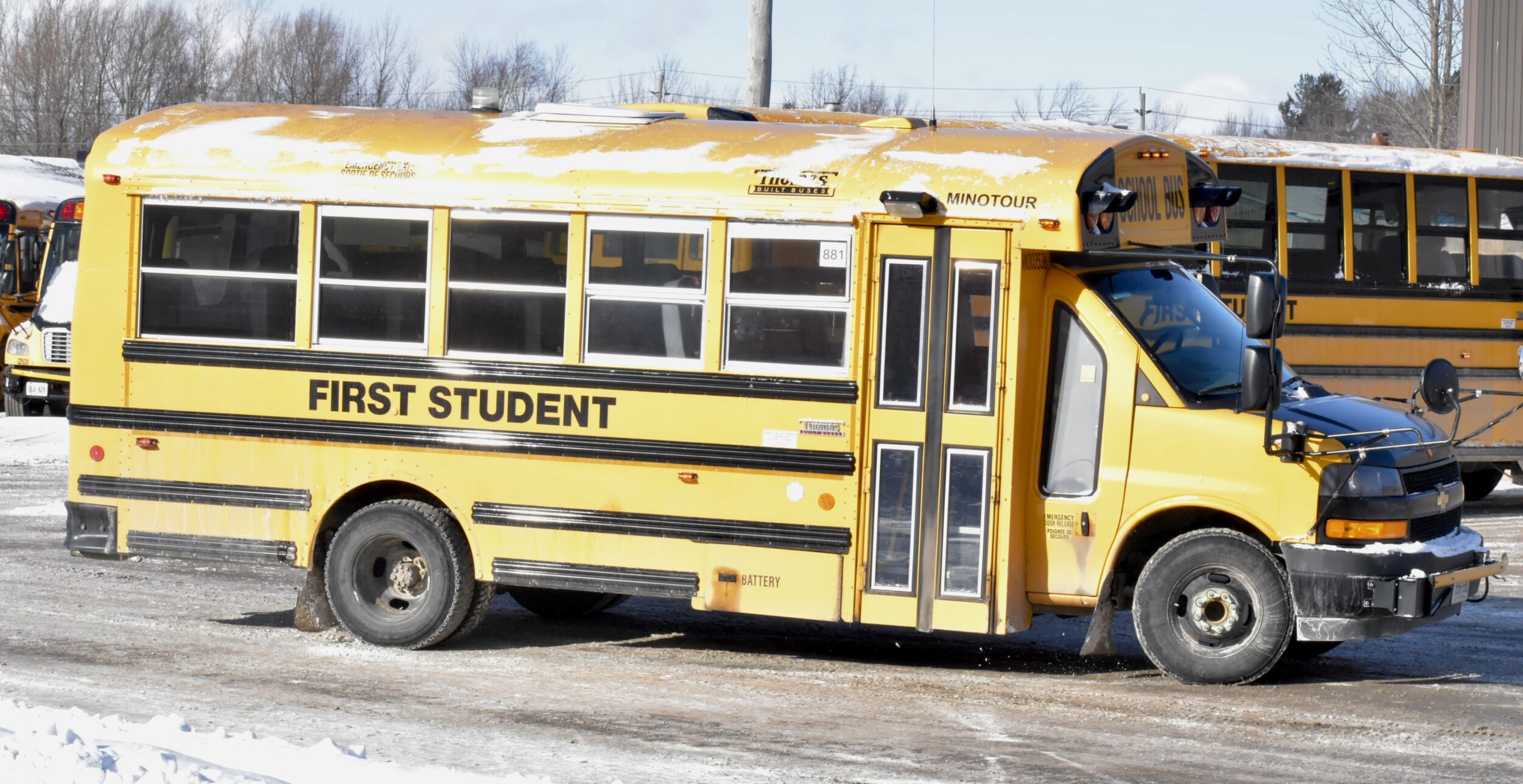 Come September 2026, First Student will no longer be serving the needs of TriBoard Transportation. (Jason Parks/Gazette Staff)
Last fall, Tri-Board Student Transportation announced the results of its first ever Request-for-Proposal process. Tri-Board organizes and oversees school busing across Quinte, Napanee and Kingston. It manage 617 routes transporting more than 31,000 children to 138 different schools.
In the County, the multinational First Student manages most routes. In Belleville and Kingston, C. Smith and McCoy, respectively, locally owned companies with decades of service to the student transportation industry, are in charge.
But next fall, everything changes. In Prince Edward, routes will be divided between Sharp Bus Lines and the multinational Switzer Carty in a new nine-year agreement.
“They come here to make a profit, and they are taking taxpayer dollars out of our province and country,” notes Wayne Brough, a retired County bus driver.
Bill 72, the Buy Ontario Act, gives the preference to Ontario or Canadian companies in public sector
procurement. Local bus companies are using it to
challenge the Tri-Board’s new bus contracts.
Switzer Carty and Sharp’s are hosting open houses for Quinte-area drivers. Current drivers who want to keep their current routes will, for the most part, be able to. David Mercer has been driving school buses in Prince Edward County for 34 years. His tenure dates back to the Laidlaw days; the North American conglomerate was absorbed by FirstStudent in 2007.

Mr. Mercer says he doesn’t expect much turnover when it comes to the local driver complement.
“A lot of the drivers, including myself, have signed up with the new companies and I’ve already been asked if I wanted to keep my route,” Mr. Mercer said. “But I didn’t really like how the RFP process went for a term of nine years? That’s a long time. TriBoard seems to have a lot of power they shouldn’t have.”
Sharp is a family-owned company based in Brantford. It was founded in 1961 by farmers Don and Mary Sharp and is managed today by his son Bill. But Switzer Carty Transportation was founded in 2011 in Brampton by Jim Switzer and Doug Carty. In the last two years, the company has acquired County Bus Lines in Foxboro and Parkhurst Transportation in Belleville as part of a large-scale expansion into Eastern Ontario.
Switzer Carty is also part of a growing trend in Ontario. Once a medium-sized student transportation solution in the Greater Toronto Area, it’s now controlled by Terramont Infrastructure Partners, who, with participation from Manulife Investment Management and Siemens Financial Services, acquired a controlling interest in Switzer Carty in 2021. Mr. Switzer remains CEO and President.
It’s the same across the province. Other Tri-Board routes have been awarded to the companies Landmark and Voyago. Voyago is a subsidiary controlled by Caisse des Depots in France and Rethmann Group in Germany. While it has some Ontario roots, Landmark is a North American conglomerate offering contracted student transportation services in rural and suburban markets across both Canada and the United States.
Family-owned Attridge Transportation based in Burlington was the fifth company to win routes through TriBoard’s new RFP process.
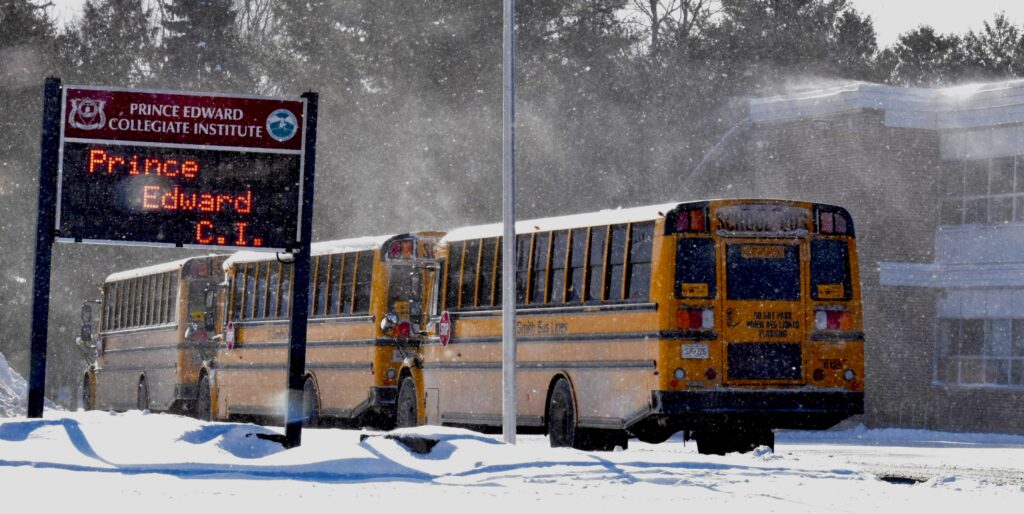
But three of the five busing companies serving families in this part of Ontario next year are multinational conglomerates.
And that’s an issue for Mr. Brough, who says such multinationals, responsible to shareholders and profit margins above all else, are not expanding into Ontario to provide better service.
Mr. Brough estimates that, not long ago, Ontario’s student transportation needs were serviced by about 100 companies of a widely varying scale. Now, the bidding pool is down to a handful of large corporations, the majority of which are controlled outside Canada.
The trend flies in the face of “Elbows Up” fervour. Mr. Brough points to Bill 72, the Buy Ontario Act, regarding Public Sector Procurement. The legislation gives the preference to Ontario or Canadian goods or to services.
But the law didn’t come into effect until after the results of Triboard’s RFP were announced. Companies C Smith and McCoy have launched a legal appeal of Triboard’s RFP decision based on the new legislation.
Student transportation is funded through an earmarked grant from the Ministry of Education. But the allotted amount doesn’t always cover the actual cost.
Public and Catholic school Boards serviced by TriBoard were invoiced $49 million in 2023-24. Regionally, the Hastings and Prince Edward District School Board saw a $1.1 million funding gap as rising transportation costs exceeded government payments.
The province blinked and provided limited transportation-transition funding. That ends at the end of the 2025-26 fiscal year. The TriBoard RFP was, among other things, expected to create cost certainty and eliminate the need for top-up or transition funding.
Glitches and legal appeals pending, however, for the drivers entrusted with taking our most precious resource to and from their daily learning, business, it seems, is usual.
“None of us would be doing this if we didn’t enjoy the work and liked being around the kids on a daily basis,” Mr. Mercer told the Gazette. “Our number one job remains getting the kids to and from school safely every day.”
See it in the newspaper