Canada’s oldest weekly newspaper
© 2026 The Picton Gazette
Since 1830


 9° Partly Cloudy
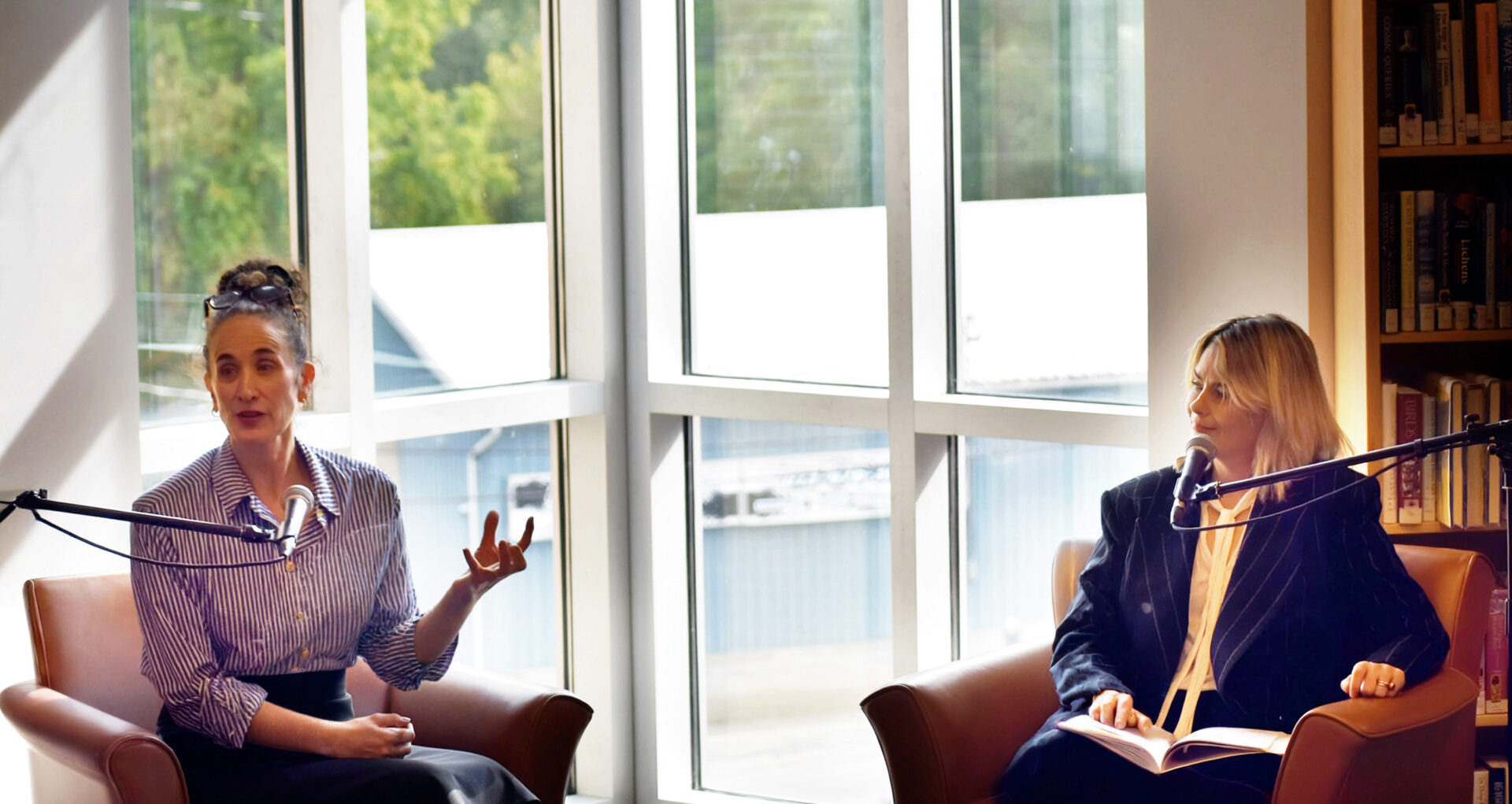 Jess Gibson and Damian Rogers (Brittiny Blodgett/Gazette Staff)
“These stories are a little unsettling. I intended them to be unsettling. In many of them, pleasure doesn’t turn out to be exactly what is expected.”
Darker currents run through the high style of The Good Eye, Jess Gibson’s debut collection of short stories.
The daughter of the writers Margaret Atwood and Graham Gibson, the writer was at the Picton Branch Library last weekend in conversation with poet and memoirist Damian Rogers. The event was moderated by Oeno Gallery’s Carlyn Moulton, an artist, curator, and longtime County resident whose own life is woven through that of the Atwood-Gibson family.
Food, art, beauty, fraud, death, the supernatural, and oblivious men recurr throughout Gibson’s collection of stories, which are connected by a focus on the instability of perception. At the center is a persistent uncertainty about what, or who, can be trusted.
Ms. Gibson, who has a doctorate in Art History from Yale, is fascinated by appearances. “What am I seeing? And how do I translate that into language or into an understanding?” is a key question, she says.
In the title story, a character is drawn in by the style and elegance of the people around her — the kind of beauty that might appear in an interiors magazine. Gibson traces the tension between loving beautiful things and how appearances mislead.
In several of the stories, Gibson pushes perception into the realm of the supernatural, where seeing something does not mean knowing what it is.
She grew up in a home understood to be haunted. She does not believe in ghosts, she said, but has had supernatural experiences. “If you read it one way, it’s a ghost story. If you read it the other way, somebody thinks they’re psychic. I’ve tried to skirt the edge of that belief.”
There is no neat resolution, which is precisely what interests Ms. Gibson. The stories offer clues, not certainties.
After her father died, she found comfort in mystery novels, where things go wrong but one knows they will be sorted. While these stories borrow some of the pleasures of the genre, they do not offer closure, especially when it comes to grief.
“I did not write mystery stories that are solved at the end,” she said. “When you’re dealing with something like grief, you don’t actually get an answer to that.”
That may be where the title The Good Eye reaches beyond its reference to art and authenticity. A “good eye” can mean knowing what is real — being able to distinguish an authentic Picasso from a fake. But the stories complicate that confidence.
They are like Rorschach tests, she says. One reader might see an optimistic ending; another might see something much darker.
It is part of the form. “Short stories are slices,” she said. “They’re just a little bit of life. And there’s a before and an after.”
The conversation flowed easily between the two, who have been friends for years. Ms. Rogers was an early editor of Ms. Gibson’s work, and the two have long shared stories and ideas.
“I love short stories. I love the concentration of attention. I like the idea that there’s no extra.” She began reading more short stories when she was living in New York with a small child, when her time was fragmented and she wanted something she could finish in a single sitting. The form eventually taught her about structure and how to sustain a reader’s belief across a longer work.
Did you always want to be a writer?
“Both of my parents wrote, so growing up, we just wrote stories.” Gibson pursued a PhD in Art History and taught for years before returning to fiction.
“I was always writing.”
See it in the newspaper