Canada’s oldest weekly newspaper
© 2026 The Picton Gazette
Since 1830


 24° Mostly Cloudy
 Resident Madeline Smolarz listens to Mark Johnson’s presentation concerning the Sir John A. Macdonald art piece Holding Court at Shire Hall April 21. (Jason Parks/Gazette Staff)
In a recorded vote of 8-6, Council denied a Brad Nieman/Bill Roberts motion calling for engagement with sculptor Ruth Abernethy and other stakeholders, including the Macdonald Group and Indigenous groups, to explore bringing Holding Court back to Main Street.
Mayor Steve Ferguson and Councillors MacNaughton, Prinzen, Engelsdorfer, Hirsch, Branderhorst, Grosso and Braney voted against the motion.
Councillors Nieman, Roberts, Harrison, St-Jean, Maynard, and Pennell were in favour.
Holding Court was unveiled on Picton Main Street with great fanfare on Canada Day in 2015.
Controversy over the first Prime Minister’s role in creating the Indigenous residential schools program led to Council ordering the statue removed in 2022.
An amendment proposed by Councillor Kate MacNaughton suggested striking “Main Street” from the original motion, opening the way to putting the statue somewhere else, was also defeated.
Holding Court was unveiled on Picton Branch Library property on Picton Main Street with great fanfare on Canada Day in 2015; intense controversy over the first Prime Minister’s role in creating the Indigenous residential schools program led to Council ordering the statue to be removed in 2021.
It has remained in municipal storage ever since.
Council voted in 2022 to return the statue to the Macdonald Group, but it refused to take it back, instead asking the municipality to honour the original agreement for public placement.
Save our History’s Mark Johnson brought the proposal to explore a resolution to Council. The Scarborough resident described the group as a non-partisan, grassroots movement dedicated to “preserving and celebrating our rich Canadian heritage by protecting our historical statues and school names.”
Mr. Johnson stressed there was no intention to diminish the tragedy of residential schools or Indigenous history, nor the collective need to improve the lives of Indigenous Canadians.
“Instead, it’s about the rightful place to honour Sir John A. Macdonald, and in particular, the statue here on Picton’s Main Street,” he said.
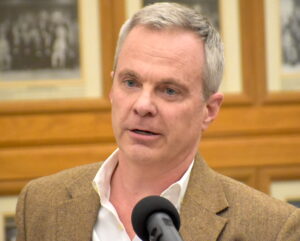
Nine Macdonald statues have been removed or torn down across Canada, most in 2021 in response to the gruesome discovery of 200 unmarked graves at the Kamloops Indian Residential School. Mr. Johnson said that the passage of time should now allow for more reasoned conversation and a more nuanced understanding of Sir John A. Macdonald’s role in establishing residential schools.
By putting Holding Court back on display, he argued, the County would demonstrate leadership across the province and nationally as well as pride in Canadian history. Vandalizing statues is easy, he said. Building up a country is something else altogether.
“’Above all, let us be Canadians’,” he said quoting Macdonald. “I know there’s some sharp disagreement on this, but we’re all Canadians here; we all want what’s best for the town, the township, and the country.”
Mover Brad Nieman said it was time for the community to have a conversation.
“It’s unfinished business. By bringing everyone together and having the stakeholders engage in a conversation, we can bring this business to a close,” he said.
When cancelling becomes the safest form of expression, said Councillor Bill Roberts, that’s a problem for public debate and liberal democracy. Debate should reach beyond immediate prejudices and social media anger.
“Unless we do that, we’re never going to get to a real Truth and Reconciliation moment in Canada,” he said.
The councillor was dogged in questioning comments from the audience that, he said, ignored the fine grain of history and the record of Macdonald’s achievements.
Councillor Kate MacNaughton asked Mr. Johnson if he had spoken to either local Indigenous peoples or the Library Board about restoring the statue to Main Street. He had not.
After the motion failed, both Mr. Johnson and Marilyn Warrick, widow of Macdonald Group founder David Warrick, departed. Ms. Warrick had registered to address Council.
More than a dozen others spoke to the motion after it failed, the majority against bringing Holding Court back to Main Street, particularly without important historical context.
Some speakers suggested the statue be relocated to Macaulay Museum, where it would form part of the Truth and Reconciliation exhibit A Path Forward. As Picton resident Christine Renault put it, “I strongly object to putting the statue in any prominent outdoor location. Not having the statue on Main Street does not erase history, it puts Macdonald’s story where it should be: not revered in public space, but presented in history books, classrooms, and museums, where Macdonald’s life and times can be explored and debated with the depth that history deserves.
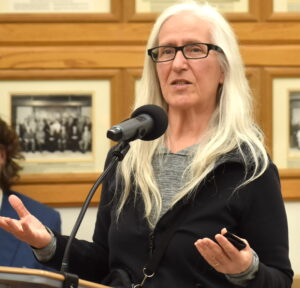
“Through our choices, let’s show real respect for Indigenous peoples, for all people, and be the community of compassion that defines, not divides, Prince Edward County,” she continued.
Others felt it was unfair to lay the long history of Canada’s mistreatment of its Indigenous peoples at the first PM’s feet, pointing to his nation building efforts after the U.S. Civil War, when there were threats of annexation from Washington.
Some invoked the current tensions between Canada and the U.S. as a reflection of the pressures Sir John A. Macdonald faced in the days leading up to Charlottetown, and characterized the return of the statue as a shoring up of national pride and unity in difficult times.
Finally, Duarte Da Silva, CEO of the Chamber of Commerce, argued restoring the statue to Main Street would represent not a path forward, but a giant step back. “From a business standpoint, the stakes are high. Reopening this debate undermines our position at precisely the moment our profile has never been higher, and threatens to generate the kind of national media attention that could cost us dearly.”
See it in the newspaper