Canada’s oldest weekly newspaper
© 2026 The Picton Gazette
Since 1830


 1° Clear
 Moodie House, Belleville (Eleanor Zichy / Gazette Staff)
Everything surrounding the stone house on Bridge Street has changed since the Moodie family lived there in the mid-nineteenth century. Once the only house on a 16-acre lot, it is now part of an established residential neighbourhood.
Inside, however, is a different story. The original blueprint of the house remains intact, with the addition of modern conveniences like electricity and running water. A sliver of wall in Susanna’s second-floor study still has her wallpaper.
At the head of the new iteration of the Moodie house is Julie Simpson, who wants to turn back the clock in every room, and preserve the house as an emblem of Canadian literary history.
Susanna Strickland Moodie was born in 1803 to great privilege and opportunity in Suffolk County, England. Her father, a dock manager, managed to buy the family a grand estate called Reydon Hall, where his six daughters grew up surrounded by gardens and with free access to their father’s vast library.
But it wasn’t long before the idyllic bubble burst.
“He’d made some bad business decisions,” Ms. Simpson said of Thomas Strickland, and the family’s prospects began to dwindle.
Susanna and her husband John Wedderburn Dunbar Moodie, an army officer, decided to journey to Canada after slick salesmen suggested a dream of the New World complete with money and cleared land.
After a difficult sail overseas, “they weren’t given the money and the land wasn’t cleared,” Ms. Simpson noted. “It was very rough and they had to learn how to do everything.”
Roughing it in the Bush, Susanna Moodie’s most famous work, offers an unstinting description of the couple’s early years in the backwoods north of Peterborough.
By the time the Moodies moved to Bridge Street, their material conditions had improved. Susanna, who became a prolific poet, novelist, memoirist, and illustrator, was earning money from her writing, and Dunbar was the first Sheriff of Hastings County. It was a time that inspired her book Life in the Clearings Versus the Bush.
“This was the clearings. This was her way out of the bush,” said Ms. Simpson.
In another bout of misfortune, however, Dunbar was forced to resign from his position in 1863, leading to a financial decline that ended with the loss of the house. Though Susanna moved around at the end of her life, today she is buried in Belleville Cemetery.
Ms. Simpson’s knowledge of Susanna Moodie’s life and work is extensive, and her connection to the house is even deeper: she moved into it with her parents at the age of seven.
Her mother, a teacher who grew up in Belleville, had always admired the house. She spotted a For Sale sign one day on a family drive.
“She came back to the car and said ‘we just bought a house,’ ” Ms. Simpson recalled. “From then on they scrimped and saved and renovated for ten years.”
The renovations brought the house up to code, such as replacing the knob and tube wiring, but kept the bones intact.
The house’s literary pedigree lived on when the Simpson family moved in. Ms. Simpson’s father, Leo, was a novelist and literary critic. Many volumes in the library are books he reviewed for The Globe and Mail.
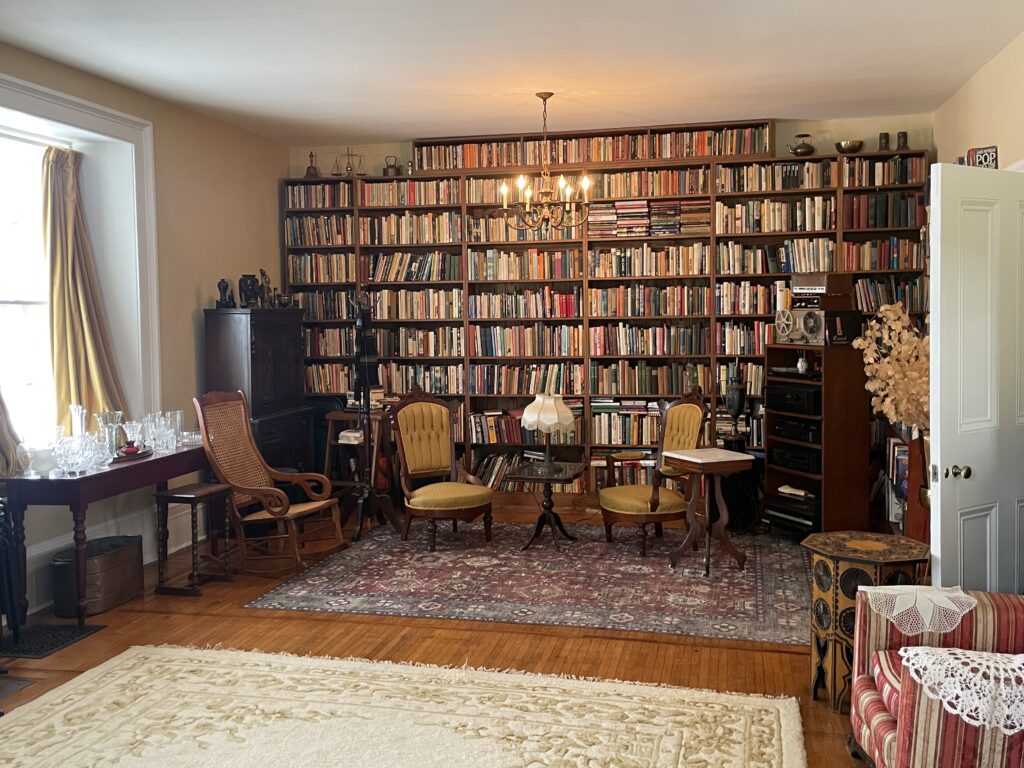
“He was part of the burgeoning of Canadian literature in the 1970s,” Ms. Simpson said. His tight-knit circle included Margaret Laurence and Margaret Atwood.
With Susanna Moodie’s legacy in mind, and the literary backdrop of her own upbringing, Ms. Simpson wants the programming on offer at the new museum to include writers’ retreats, artist salons, and art shows.
“What I’m hoping to do here is bring back the idea of a cultural centre for the community, for exploring the arts and the written word.”
While the grand public opening is waiting on the requisite permits, Ms. Simpson is already hosting small events in a series of soft launches.
The restoration is also ongoing by the house’s small team; Kirk Tischbein is Creative Coordinator, and Larry Munnings Facilities and Preservation Manager.
The phased approach the team is taking also allows them to grow their repository of information and artifacts from Susanna Moodie’s time. Already, Ms. Simpson notes, people are coming out of the woodwork to share their connection to the literary legend. She welcomes anyone to come knock on the door.
See it in the newspaper