Canada’s oldest weekly newspaper
© 2026 The Picton Gazette
Since 1830


 24° Mostly Cloudy
 Editorial
E.M. Forster is famous for an enigmatic phrase that sounds throughout his masterpiece, 1910’s Howards End, “only connect.” The novel celebrates home and the sense of place, holding them up against the steady, despoiling creep of industry and commerce at the beginning of the twentieth century.
While the phrase suggests connection with others, it also means to connect the different parts of oneself, the inside and the outside, to live more authentically — without internal coherence and integrity it is just not possible to connect with others.
If Forster were here today, I often think he might have to simplify a bit. “Only disconnect,” he might say.
There are signs that our siloed and anxious society is taking stock of what living online drains from the real world, and reclaiming some of what has been lost. There’s a reason the words “intentional” and “sustainable” are now so important. Amidst the crazy of life on social media platforms, more and more of us just want our peace of mind back.
And that has meant, in turn, a small but significant renaissance of print culture. Books. Newspapers. Magazines. Vinyl.
If you thought, for example, that when County Magazine founder Steve Campbell, who published nearly 200 issues almost singlehandedly over the 50 years since 1976, passed away last year, that his magazine would quietly slip away too, well, you were wrong.
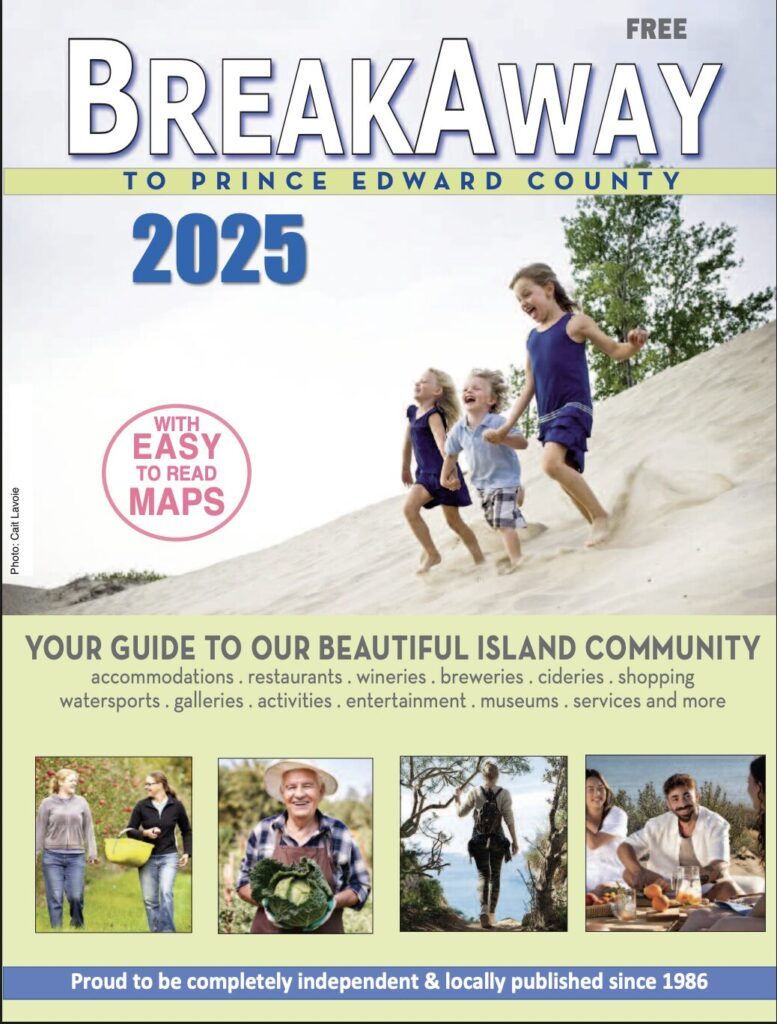
It’s been snapped up by the new publisher of Watershed, Karine Ewart, who has lived and breathed magazines her entire working life. Ewart is interested in both the quarterly — 1000 copies of each issue of the County Magazine are distributed locally — and its spin off brands, @Home Magazine, which distributes 12,000 copies, and Breakaway, another 30,000. She’s also interested in creating synergies with Watershed’s strong advertiser base.
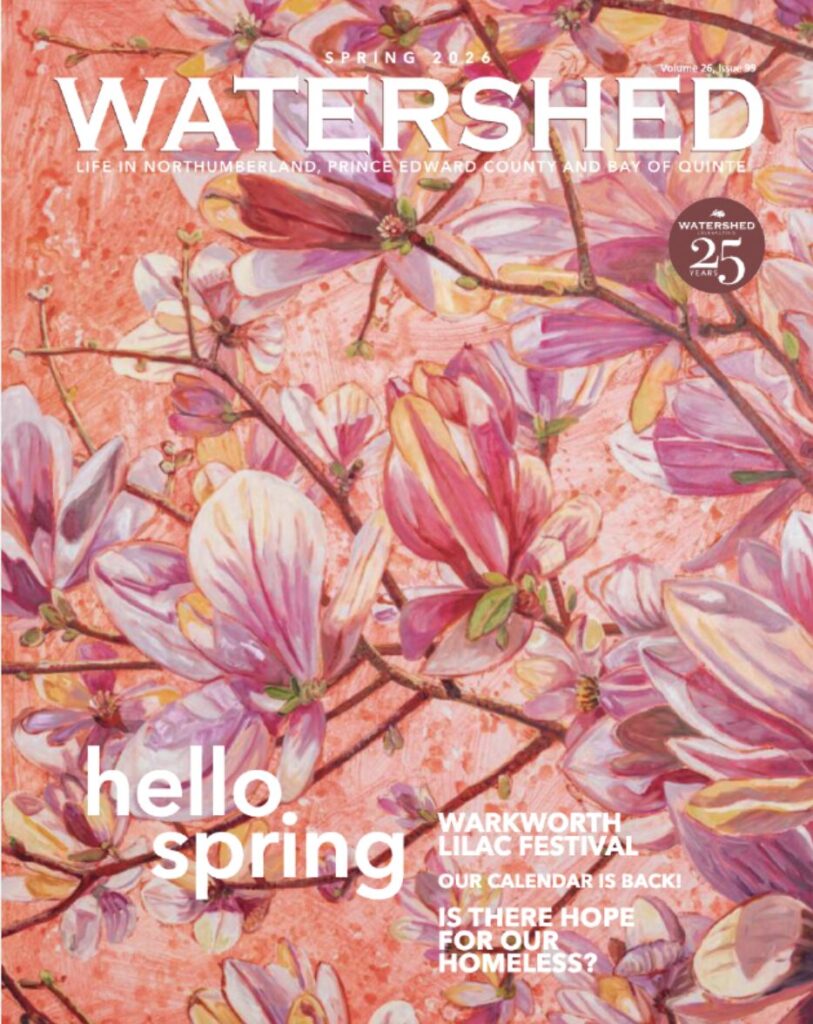
For now, though, she’s going to take a year and just see how everything works.
After journalism school, Ms. Ewart headed to New York for a dream job at the fashion magazine Harper’s Bazaar. That was during the 1990s, the heyday of publishing, a world of huge budgets, wine at lunch, and enormous creativity celebrated in The Devil Wears Prada.
She was back in Canada, at Chatelaine, during the digital transition of the 2010s. Print media scrambled for over a decade to shift gears, only to discover, too late, that the digital advertising market was rigged in advance. “The ads were not performing. Metrics showed they weren’t performing,” she remembers. The shift to digital was the beginning of a massive, industry-wide decline from which only Google and Meta would emerge triumphant.
“The focus is the here and now, right here, in real life.
Karine Ewart, Publisher, Watershed and County Magazine
That’s the market for print.
It’s tangible, it’s got texture.
And it flourishes in community.”
Today, Canada’s digital advertising market is worth $21 billion, most of which is siphoned out of the country by “the duopoly.” The disastrous consequences for journalism and print media in general of the “tech bro” ascendancy are just one piece of a bigger picture. The online world’s absorption of crucial shopping and advertising dollars as well as attention spans has impoverished our minds, communities, and institutions.
They hit us where we live.
In 2018, Ms. Ewart, who lives in Northumberland, met with Watershed’s founder and publisher Jane Kelly. “I was on my digital high horse then. I was at Rogers Media, at Today’s Parent, and I kept telling Jane she needed to put more into the website, that digital space.”
The two had lunch every year for 7 years. And at their last lunch, “I apologized. I said I was wrong 7 years ago about investing time and money in the digital space. Watershed is a print product, and that is what we need to focus on.”
It had become clear by then that digital advertising wouldn’t sustain most websites. In the media world, shifting from print to digital often meant only a serious loss of revenue.
“If it’s Google-able, if you can look it up on Google, then it’s not local, it’s not tangible, and it’s not relevant — it’s not the here and now,” says Ms. Ewart.
“Think of a recipe. I love my cookbooks, I really do, but now when I need a recipe, I Google one. It’s fast, it’s quick, I know where it is.
“But if I went to a restaurant, and I wanted that particular recipe, and with it a memory, and an experience, that’s the local.” She points to an article in the latest Watershed about Alex Bruce, who opened The Lark in Belleville in 2019. “That story, like that restaurant, that chef, is unique to here. It has an authenticity, and creates a sense of — more than that, a connection to — this place.
“That is something you are only going to find in print.”
Print. It’s been there all along. It’s an old, old world technology. Gutenberg invented the printing press about 1450. Compared to the shimmer and glimmer of the internet, it seemed cumbersome, slow, and expensive at the beginning of the second millennium. And yet, against all the odds, it’s back in vogue.
The very effort, care and expense required to produce a printed artefact, Ms. Ewart notes, read now as authenticity, credibility, and connection.
Magazines are flourishing if they serve a niche or a passion. Motorcycle enthusiasts. Gardeners. Interior Design. Cooking. Women’s Health. Running. Travel. Chess. Books.
Equally, newspapers and magazines are thriving if they have a strong connection to their local communities. “The hyperlocal, the niche, the true to brand” — these are Ms. Ewart’s keywords.
“The focus is the here and now, right here, in real life. That’s the market for print. It’s tangible, it’s got texture. And it flourishes in community.”
Accordingly, she has no plans to merge County Magazine and Watershed. “Their distinct identities are their strength.”
“Even social media,” she notes, “when it really works, works at the micro level, pulling in residents, friends and neighbours, for dinner at the local pub, to try a new restaurant, to join a fundraising event.
“Otherwise, its influence is exaggerated. Those ‘followers’ an influencer has are not your followers, they are not your audience.”
The crucible of social media, she thinks, is coming to an end. “As always, we are 20 years behind what is happening. And now we have grave concerns about what it is doing to our children. Never mind the distraction and the interruption it creates. I think its influence has peaked.
“Meanwhile, niche print is sustainable and intentional. It has a future.
“The evidence is all around us.”
Both County Magazine and Watershed celebrate significant milestones this summer: 50 and 25 years in print, respectively.
“Print is not going anywhere,” she says. “In fact, it’s only going to get more desirable. People miss what it offers, that sense of peace, of place, and of a shared culture.”
She laughs, as she does often.
“At least, I think so, and I’m betting the farm on it.”
See it in the newspaper