Canada’s oldest weekly newspaper
© 2026 The Picton Gazette
Since 1830


 9° Clear
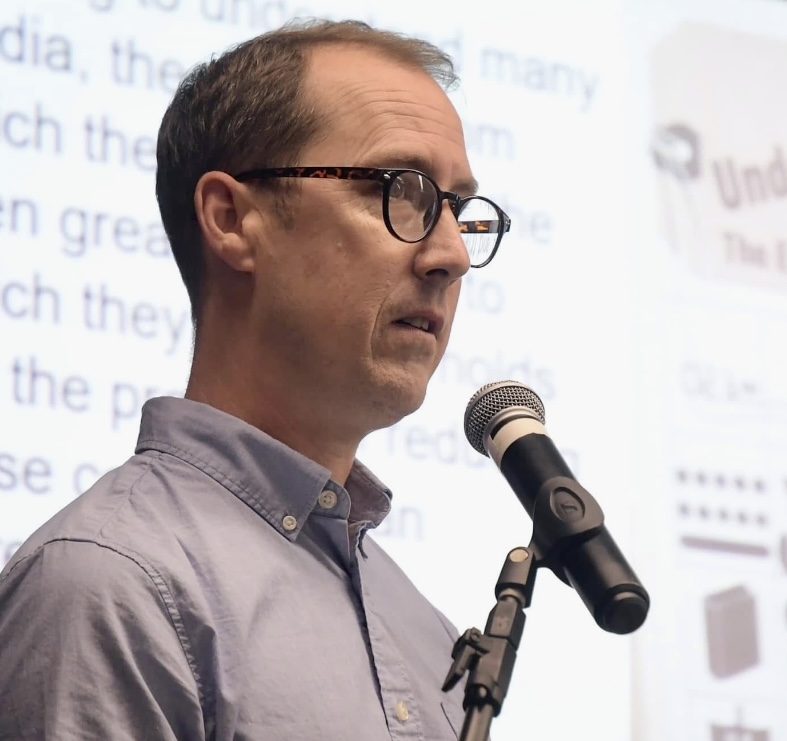 Andrew McLuhan (Photo Supplied)
Inheriting his father’s library and grandfather’s papers, he carries and curates the torch his grandfather, media theorist Marshall McLuhan, lit with a single line.
McLuhan drew attention to the way human technologies become more important than what they seem to say, or sell. “He understood that the major changes in our selves, our senses, our minds, our world come from the form and the environment of these technologies, more than from the content. In fact, the content is kind of what keeps us busy. Meanwhile all this other reorganization is happening.”
The invention of print in the 15th century was a radical technology because it spurred widespread literacy, and made humanity think of itself differently—globally.
The medium is what happens to you — and that is the message.
It can be anything from a lightbulb, to a social media platform, to a community.
The idea of a medium is not limited to what we today think of as “media” — though social media is a textbook example of the transformative effect — for good or ill — of a new medium. Its importance is in the environment it creates. Something as simple as a lightbulb creates an environment.
A medium is a culture, “because new technology becomes new habits and new values.” Andrew quotes his grandfather: “the medium is what happens to you, and that is the message.”
“My grandfather also said that environments are not static, they are active processes that shape people. And this comes back to our community. Our community is an environment, and the conditions of a community make certain things possible and certain things less likely.”
The McLuhan Institute is a platform for teaching, writing and research, as well as an archive. “This place is here in order to keep learning and discovering. This work is so huge: culture and technology touch on everything,” notes Andrew.
“It’s good to preserve history, but what we really need are tools, ways for exploring, understanding what’s happening now, and what’s coming next.”
Arriving to the County in his final year of high school, Andrew apprenticed with his family’s neighbour, Ed Richards, and learned the upholsterer’s trade.
He uses a familiar phrase, “a sense of place,” to describe what’s special about the County, and notes one key example: The Regent Theatre.
For a decade, Andrew was the Regent’s Wednesday night projectionist, while film slowly gave way to video. “Interestingly,” he observes, “an upholsterer’s sewing machines and a projectionist’s film machines are kind of similar: you know, you’re running a line of stitches down a piece of thing, or you’re running the film through a projector. They’re not unrelated.”
Next Saturday, Andrew will bring his philosophy to The Regent’s Annual General Meeting. “These kind of cultural spaces are important,” he asserts. “If we want to preserve the things that we like about a place—that we value about living in a place—we have to preserve these cultural spaces and affordances. There’s really no two ways about it.
“And, crazy idea: make room for more.”
The Regent AGM is open to everybody. Executive director John Galway notes “there are many ways to participate in this community theatre. With a donation, you can join the Theatre Foundation, and become a voting member at the AGM. Or you can join the Film Club for an annual fee, and enjoy discounts on every ticket. Or you can do both!”
The Regent AGM is Saturday 21 March at 10am.
See it in the newspaper