Canada’s oldest weekly newspaper
© 2026 The Picton Gazette
Since 1830


 -3° Clear
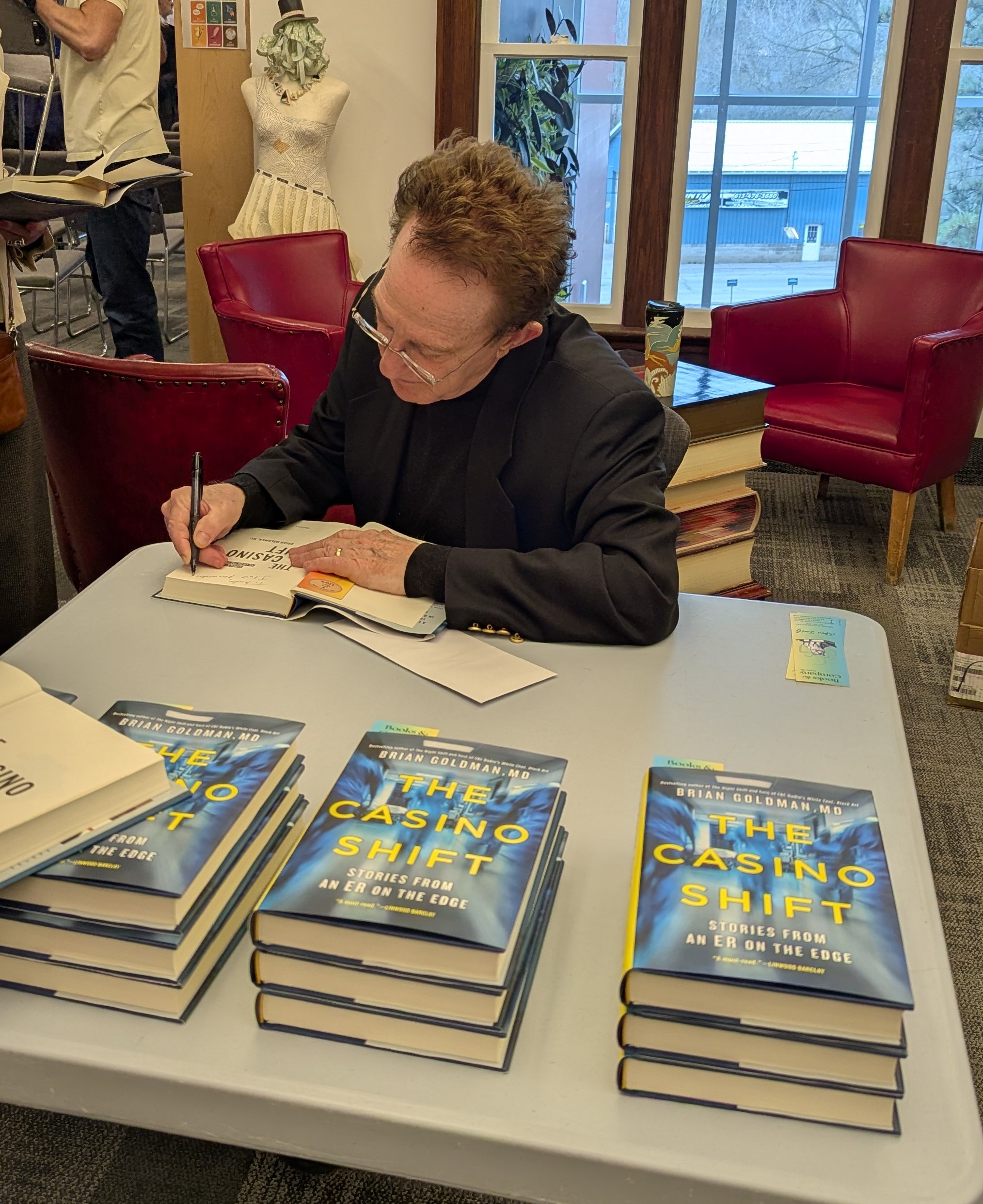 Dr. Brian Goldman at the Picton Public Library. (Photo: Chris Fanning / Gazette Staff)
Veteran emergency doctor, CBC Radio host, podcaster and author Dr. Brian Goldman was at the Picton Public Library to talk about The Casino Shift: Stories from an ER on the Edge. The County’s own Dr. Andrew Janikowski led an interview.
Between the two doctors, a portrait of a health care system in crisis emerged, as well as reflections upon possible solutions.
Dr. Goldman is a personable communicator who wants to bridge the gap between the way medical professionals talk to each other and the way they talk to their patients. He described coming to Emergency Medicine through “a combination of ambition and insomnia.” He liked the “jitterbug, ADHD, going from patient to patient” of the E.R., and stressed a “situational awareness” is key in making decisions.
He also found himself writing — including an unpublished script of a Star Trek episode.
Dr. Janikowski turned the conversation to “the new normal” in emergency rooms across the country — hallway medicine and crammed ERs. Many of the stories in Casino Shift read, he noted, “like a scary Stephen King novel: moments that are systemic, not individual patient issues.”
Patient load is the main driver,” said Dr. Goldman. Mount Sinai Hospital’s E.R., for example, has gone from 70 cases per day to 220. He described “moral injury” — the fact of patients being made to suffer physical pain while waiting.
“10 or 15 years ago, when I wrote my first book, The Night Shift, we didn’t talk about the collapse of the emergency system,” said Dr. Goldman. “Today people bandy about that word. … It’s gone from a ‘never’ event to just something that happens. The small, rural, and remote emergency departments are one nurse away from closing.”
The burnout rates of medical professionals, especially nurses, is 1 in 10. 1 in 4 wish to leave their current position. Likewise, like the problem of primary care, which stems from bad decisions made in the 1990s, there is now a shortage of emergency doctors across Canada.
Solutions need to be found, or existing solutions need to be embraced. “Virtual emergency medicine” could allow for triage by a doctor remote from a rural E.R. “They can already listen to breath sounds across a tablet, and heart sounds. They can look inside your ear, at the back of your throat, and I think that we’re coming to the day when you’re going to be able to much more.”
At the same time, “it is known that treatment closer to home is better for many reasons. So we need to weigh closures against embracing technical assistance.”
Dr. Janikowski asked if there is any cause for optimism. Dr. Goldman stressed how impressed he is with his colleagues. “As long as we have the zest to work on these issues, then I think that the future of emergency medicine is in great hands. There’s a lot of enthusiasm and optimism coming from the trenches.”
And then he came to the most important statement of the day: “we need to have an adult conversation about private for-profit healthcare.” He pointed to European models that are more regulated than our “laissez-faire” system, which blend private and public care in a principled way.
“We need to talk about how we fund healthcare and what kind of healthcare system we want. That’s the last thing I left as a question for Canadians, because I think one of the reasons for writing the book is that I want people to know not how I wish it were, but how it is.”
See it in the newspaper